

The Minister of Education, Dr. Maruf Tunji Alausa, has reaffirmed the commitment of the President Bola Tinubu administration to the development of non-formal education as part of efforts to promote job creation and youth empowerment across Nigeria.
Alausa stated that the Federal Government, through the Ministry of Education, is intensifying efforts to empower out-of-school children through informal education while equipping students in formal institutions with entrepreneurial and vocational skills.
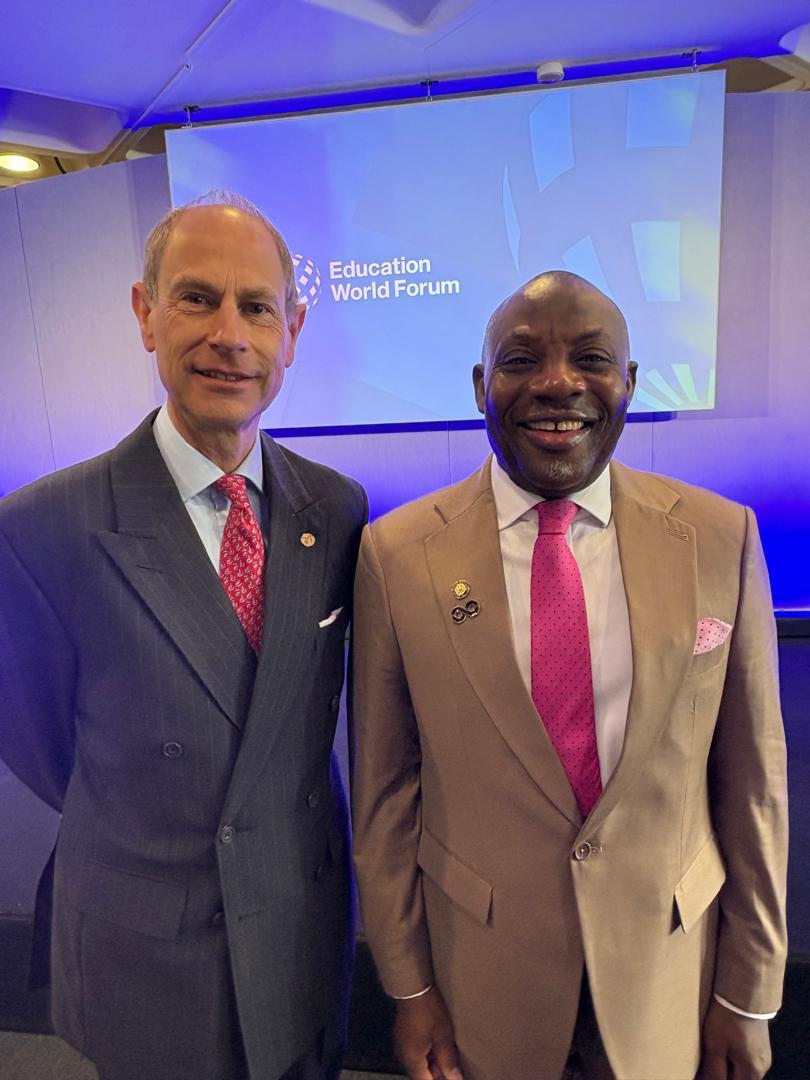
According to a statement issued by the Special Adviser to the Minister on Media and Communications, the minister spoke during a special plenary session moderated by His Royal Highness, Prince Edward, the Duke of Edinburgh, at the ongoing Education World Forum (EWF) in London, United Kingdom.
Other panelists at the session included the Minister of Education for Ontario, Canada, Paul Calandra; the Secretary of State for Education, Rio Grande do Sul, Brazil, Raquel Teixeira; and International Youth Representative of the Duke of Edinburgh International Award Foundation, Andrea Chakma.
The session focused on the importance of non-formal education, soft skills development and industry collaboration in improving employability and individual wellbeing.
During his presentation, Alausa highlighted several Federal Government programmes targeting out-of-school youths, adults and vulnerable groups through literacy, vocational and technical education initiatives.
“What we are doing in Nigeria is because we have a lot of out-of-school children, we have to find a way that we can quickly get them a kind of non-formal education,” the minister said.
He explained that the government had developed an Accelerated Basic Education Programme aimed at helping out-of-school children catch up academically while also acquiring practical skills.
Alausa said the ministry had also intensified focus on Technical and Vocational Education and Training (TVET) to provide young Nigerians with additional skill sets that would enable them to contribute meaningfully to society and improve their livelihoods.
“We’ve heavily focused on technical vocational education, which is still a form of formal education but in a non-formal setting to give people that have gone to school other skill sets that they can use to benefit themselves and benefit their community,” he said.
The minister added that entrepreneurial training had been integrated into educational programmes to equip students with innovation and business skills, while digital literacy initiatives were also being expanded to prepare youths for the future economy.
Among the initiatives highlighted by Alausa were the tuition free TVET programme, the National Policy on Skills Development, programmes for Mass Literacy, Adult and Non-Formal Education, as well as the Almajiri and Out-of-School Children Education Programme, which integrates traditional Quranic education with vocational and basic learning.
According to him, the overall objective of the programmes is to equip Nigerian youths with relevant skills for present and future opportunities.
“The whole goal of what we are doing here is to really get them the skills skills for the present and skills for the future,” he said.
The minister also commended the Duke of Edinburgh for visiting Nigeria in November 2025 and noted that Nigeria remains part of the Duke of Edinburgh International Award Foundation.

