


Nigerian manufacturers are paying two to ten times more for basic operational inputs than their global competitors, threatening the country’s ability to compete under the African Continental Free Trade Area (AfCFTA), the National Sugar Development Council (NSDC) has warned.
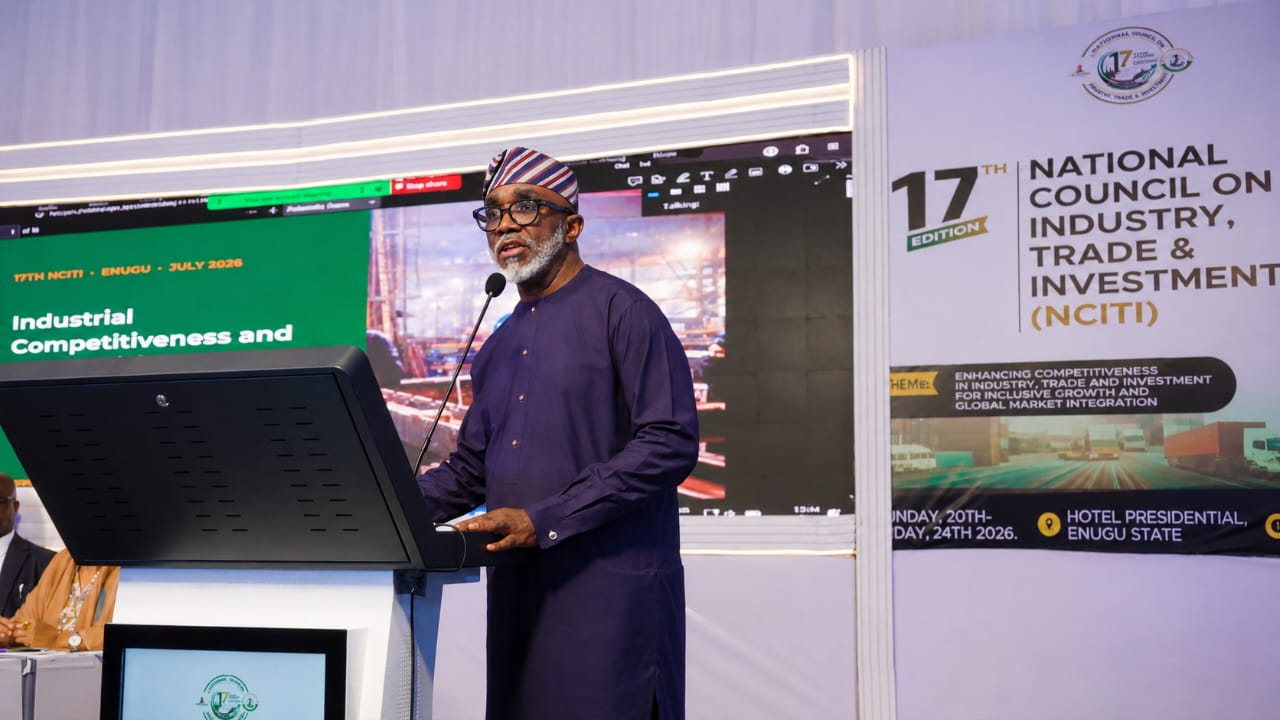
Speaking at the technical session of the 17th National Council on Industry, Trade and Investment (NCITI) in Enugu, Kamar Bakrin, Executive Secretary of the NSDC, urged the Federal Government and state authorities to take decisive action to slash the cost of industrial production or risk conceding the continental market to foreign competitors.
Presenting a comparative analysis between factory operations in Nigeria and emerging industrial hubs like Vietnam and China, Bakrin noted that Nigerian manufacturers face severe cost disadvantages across three key areas: power, finance, and logistics.
Industrial electricity costs in Nigeria stand at 15 cents per kilowatt-hour on the national grid, soaring to nearly 30 cents when running on diesel generators, compared to 8 cents in Vietnam and 10 cents in China. According to Bakrin, Nigerian manufacturers spent an estimated ₦1.34 trillion on self-generated power last year alone.
Working capital interest rates for Nigerian firms range between 27 and 35 percent, compared to 9 percent in Vietnam and 3 percent in China. Additionally, Nigeria ranks 88th out of 139 countries on the World Bank’s Logistics Performance Index, well behind Vietnam (43rd) and China (19th).
Consequently, despite access to a domestic market of 230 million people and a broader regional market of 1.4 billion under AfCFTA, manufacturing contributes barely 8 percent to Nigeria’s Gross Domestic Product (GDP), with average factory capacity utilization dropping to 57.7 percent.
”None of this is a demand problem,” Bakrin stated. “It is a cost-of-production problem — and costs, unlike demand, are within our power to fix.”
Pointing to Nigeria’s domestic urea industry—which expanded capacity from 500,000 tonnes in 2005 to 6.5 million tonnes today—Bakrin highlighted how treating natural gas as an industrial input rather than a revenue source turned the country into a top-ten global exporter of nitrogen fertilizer.
To address current industrial challenges, Bakrin presented four key resolutions for adoption by the Council:
- Dedicated Power Clusters: Every state must designate at least one industrial cluster with a dedicated, reliable power arrangement within 12 months, targeting 8–10 cents per kilowatt-hour.
- Logistics Compact: A joint federal-state agreement to eliminate informal roadside checkpoints and harmonize levies along primary industrial corridors.
- State Industrial Index: The introduction of an annual public ranking evaluating states on power availability, land access, logistics, and local levy structures to encourage sub-national competition.
- “Nigeria First” Procurement: Mandatory enforcement of local procurement policies for government agencies at federal and state levels, tracked via quarterly compliance dashboards.
Bakrin emphasized that government incentives, including tax credits and subsidized power, should strictly adhere to a performance-based model similar to the NSDC’s Backward Integration Programme, where support is tied to independently verified output.
He also urged state governments to leverage the Electricity Act 2023 to establish local power markets, streamline land titling for real physical access, and align technical college curricula with state industrial priorities.
In his closing remarks, Bakrin recommended that the Council adopt six specific targets to benchmark future industrial progress: expanding manufacturing to 15 percent of GDP, reducing industrial power costs to roughly 10 cents per kilowatt-hour, bringing manufacturing loan rates below 10 percent, cutting port clearance times to under seven days, expanding duty-free continental market access, and absorbing four million new job seekers annually into the industrial workforce.

