
From the Taj Mahal to the Temple of Trust: My BRICS 2026 Media Journey Through India’s Heritage and Financial Power

By Idehai Frederick
As one of about 100 journalists invited on a familiarisation tour ahead of the 2026 BRICS Summit in India, I had the rare privilege of experiencing firsthand a nation that seamlessly blends ancient civilisation with modern innovation, cultural influence with technological advancement, and historical preservation with ambitious economic growth.
The journey took us across several of India’s most iconic landmarks and strategic institutions, from the timeless splendour of the Taj Mahal in Agra to the bustling financial heart of Mumbai, offering valuable insight into the forces that have positioned India as one of the world’s most influential emerging economies.
More than a media tour, it was an immersive exploration of how India leverages its history, creativity, financial infrastructure and technological prowess to strengthen its role on the global stage.
ENCOUNTER WITH TIMELESS GRANDEUR AT THE TAJ MAHAL
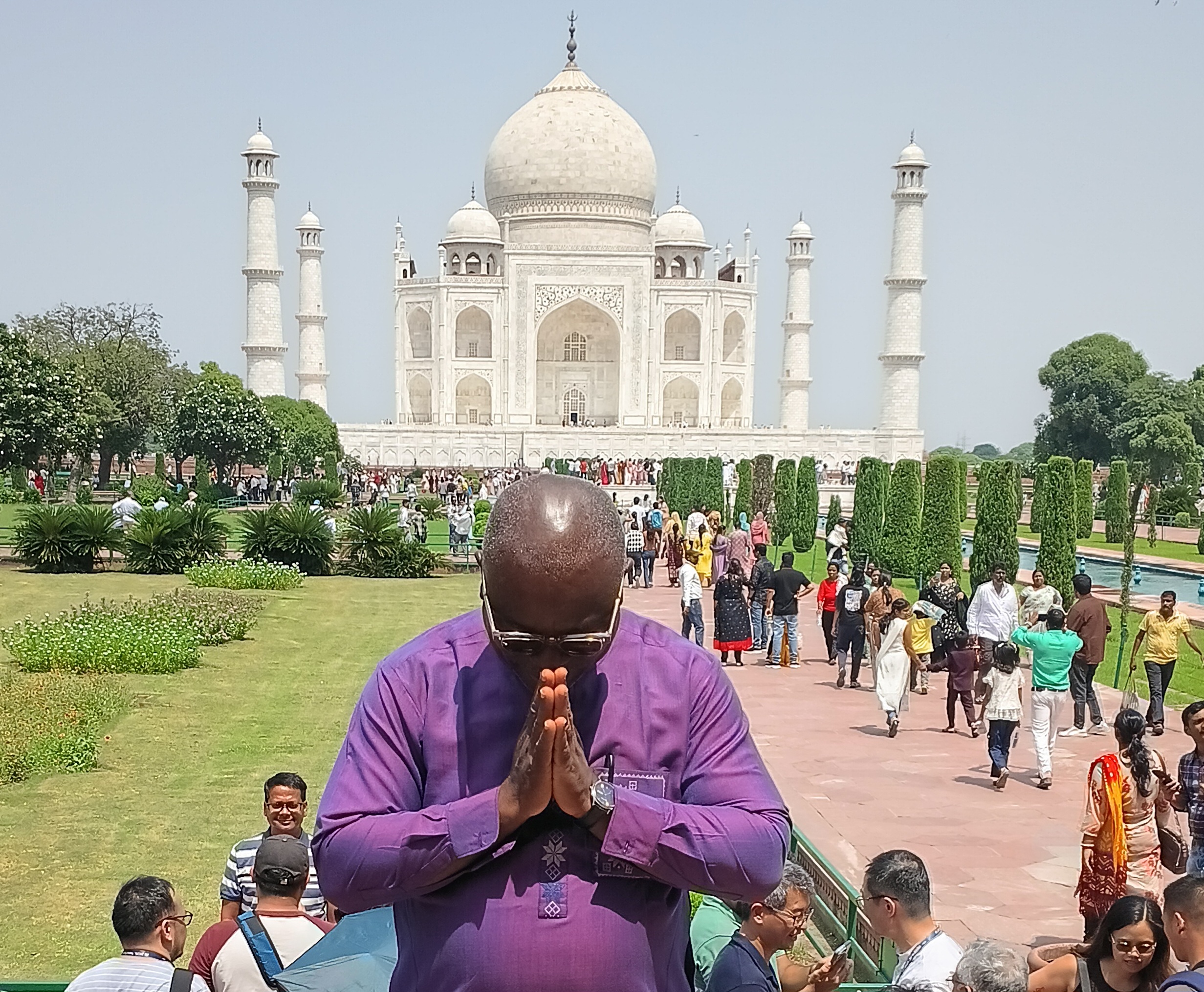
Our journey began in Agra at the magnificent Taj Mahal, one of the world’s most recognised landmarks and a UNESCO World Heritage Site.
Commissioned in the 17th century by Mughal Emperor Shah Jahan in memory of his beloved wife, Mumtaz Mahal, the white marble monument continues to stand as an enduring symbol of love, architectural brilliance and artistic excellence.
As the first rays of sunlight illuminated its gleaming domes and intricate marble inlays, the monument revealed why it remains one of the most admired structures in human history.
Every detail, from the perfectly symmetrical gardens to the exquisite craftsmanship embedded in its walls, reflected a remarkable fusion of engineering and aesthetic sophistication.
Beyond its architectural beauty, the Taj Mahal represents an important economic asset for India. Millions of visitors travel annually to witness its splendour, supporting thousands of jobs across tourism, transportation, hospitality, handicrafts and retail sectors.
The monument stands as a powerful example of how cultural heritage can contribute directly to economic development while preserving national identity.
For those of us visiting ahead of the BRICS Summit, the Taj Mahal offered an important reminder that a nation’s history remains one of its greatest diplomatic and economic resources.
EXPLORING MUMBAI: WHERE CREATIVITY FUELS COMMERCE
The tour later moved to Mumbai, India’s commercial capital and home to one of the world’s largest and most influential entertainment industries.
A major highlight was our visit to Mumbai’s famous Film City, the sprawling production complex that serves as the epicentre of India’s film and television industry.
Spread across hundreds of acres, Film City hosts an enormous range of productions, from blockbuster movies and television programmes to digital content and commercial advertising campaigns. It is a hub where creativity meets enterprise.
Often associated with Bollywood, India’s film industry has evolved into a global cultural force, producing thousands of hours of content annually and reaching audiences far beyond the country’s borders.
Our visit provided a fascinating glimpse into the enormous ecosystem that supports the industry. Behind every successful production is an army of actors, directors, producers, cinematographers, editors, costume designers, make-up artists, sound engineers, visual effects specialists and technical crews.
The economic impact extends well beyond the screen. The industry stimulates investment and employment across tourism, fashion, music, hospitality, transportation, marketing and technology sectors. It also enhances India’s soft power by projecting its culture, traditions, languages and values to international audiences.
For journalists observing operations within Film City, it became clear that India’s creative economy represents far more than entertainment; it is a major contributor to national income, job creation and global influence.
DISCOVERING INDIA’S DIGITAL FINANCIAL REVOLUTION AT THE NPCI
Another significant stop was the National Payments Corporation of India (NPCI), the institution at the centre of India’s digital payments revolution.
The visit offered valuable insight into how India has transformed financial transactions through technology and innovation. NPCI has played a key role in expanding financial inclusion by providing digital payment infrastructure that allows millions of citizens and businesses to perform transactions seamlessly and securely.
The organisation’s payment architecture has revolutionised everyday commerce, enabling rapid transfers, digital banking and cashless transactions across urban and rural communities alike.
The experience underscored India’s commitment to building a technology-driven economy and demonstrated how digital financial infrastructure can become a powerful catalyst for economic growth, efficiency and inclusion.
INSIDE ASIA’S OLDEST STOCK EXCHANGE
One of the most enlightening moments of the tour came during our visit to the Bombay Stock Exchange (BSE), Asia’s oldest stock exchange and one of the pillars of India’s capital markets.
Addressing the international media delegation, BSE Managing Director and Chief Executive Officer, Sundararaman Ramamurthy, recounted the extraordinary journey of an institution that has evolved over more than 151 years.
According to him, the origins of India’s organised securities market can be traced to a group of traders conducting transactions beneath a banyan tree in Mumbai. Over time, this informal gathering evolved into the Native Share and Stock Brokers Association before ultimately becoming the modern Bombay Stock Exchange.
Standing inside the historic trading hall offered a vivid illustration of how dramatically financial markets have evolved.
The traditional open-outcry trading ring, once filled with brokers shouting bids and offers, has disappeared.
“Today there is no trading ring,” Ramamurthy told the delegation.
Trading has transitioned from exchange floors to brokerage offices, then to personal computers and now directly onto smartphones.
The transformation mirrors India’s wider digital evolution and highlights the growing accessibility of financial markets.
A TEMPLE OF TRUST
A particularly memorable observation came when Ramamurthy described the modern role of stock exchanges.
“What it has resulted in is this place is no longer a simple stock exchange. It is a temple of trust,” he said.
The phrase captured the essence of what successful capital markets require: transparency, strong regulation, investor confidence and institutional integrity.
Ramamurthy disclosed that approximately 260 million unique investor accounts now participate in India’s securities market.
While substantial, he noted that this still represents only a fraction of the country’s population of over 1.3 billion people, signalling considerable growth potential.
He emphasised that stock exchanges perform a crucial developmental role by converting household savings into productive investments that finance businesses, create jobs and support national economic growth.
INDIA’S EXPANDING GLOBAL FINANCIAL INFLUENCE
The BSE chief also highlighted India’s emergence as a major player in global derivatives trading, particularly in stock index options.
According to him, the country’s financial markets are supported by sophisticated technological infrastructure, transparent audit systems, electronic ownership records and efficient settlement processes.
Investors receive securities directly into their Demat accounts, while proceeds from sales are swiftly transferred into linked banking accounts, creating a secure and seamless investment environment.
Ramamurthy pointed to India’s T+1 settlement cycle as evidence of increasing market efficiency and investor confidence.
“There are lots of products, lots of members, lots of foreigners participating, with technology as a backbone,” he observed.
He also discussed the expanding opportunities for international investing through exchange-traded funds, mutual funds with overseas exposure and India’s Liberalised Remittance Scheme.
Particular attention was given to Gujarat International Finance Tec-City (GIFT City), which is increasingly serving as a bridge connecting global investors with Indian and international financial markets.
CLIMATE RESILIENCE IN AN ERA OF GLOBAL UNCERTAINTY
The tour further exposed participating journalists to conversations on climate resilience and infrastructure sustainability through engagements with officials of the Coalition for Disaster Resilient Infrastructure (CDRI).
Director General Amit Prothi highlighted the organisation’s growing role as a technical partner to international platforms including BRICS, the G20, United Nations initiatives and major climate conferences.
He explained that resilience is not simply about preventing disasters but also about ensuring rapid recovery.
“The speed of recovery matters. The longer it takes countries to rebuild, the greater the impact on communities and national economies,” he remarked.
He noted that while some countries recover relatively quickly after disasters, others may spend more than a decade rebuilding damaged infrastructure, with severe economic and social consequences.
The discussions explored innovative financing solutions, including insurance mechanisms and stronger private-sector participation, aimed at accelerating post-disaster reconstruction.
Harnessing Artificial Intelligence for a Safer Future
A particularly forward-looking aspect of the discussion focused on the growing role of artificial intelligence, satellite technology and predictive analytics in disaster preparedness.
Prothi revealed that CDRI has developed a global risk database capable of estimating infrastructure losses and identifying vulnerabilities across different sectors.
He explained that various infrastructure systems face distinct risks. Power transmission networks may be highly vulnerable to cyclones, while buildings often face greater threats from earthquakes.
“There is an incredible amount of work under way on using data and predictive models. This will be one of the most important conversations over the coming years,” he said.
His remarks reflected India’s increasing emphasis on integrating technology and scientific research into long-term resilience planning.
EXPERIENCING MUMBAI BEYOND THE BOARDROOMS
The familiarisation programme extended beyond institutional visits and formal briefings.
We explored the historic Gateway of India, one of Mumbai’s most recognised landmarks and an enduring symbol of the city’s colonial and post-independence history.
Standing along the Arabian Sea waterfront, the monument offered a powerful reminder of Mumbai’s role as a gateway connecting India with the world.
A boat trip to the ancient Elephanta Caves provided another remarkable cultural experience. The UNESCO-listed cave complex, renowned for its centuries-old rock-cut sculptures and temples, showcased the depth of India’s artistic and spiritual heritage.
Our visit to the Chhatrapati Shivaji Maharaj Vastu Sangrahalaya, one of India’s premier museums, further enriched our understanding of the country’s civilisation, displaying priceless collections spanning art, archaeology and natural history.
Equally memorable was the opportunity to visit local markets, where vibrant trading activities reflected the entrepreneurial spirit that drives India’s vast informal economy.
The bustling streets, colourful handicrafts, local delicacies and interactions with traders provided a more intimate view of daily life and commerce beyond official institutions.
UNDERSTANDING INDIA’S TRANSFORMATION
The familiarisation visit ultimately told a compelling story about a nation undergoing extraordinary transformation while remaining deeply connected to its roots.
From the timeless beauty of the Taj Mahal and the creative dynamism of Mumbai’s Film City to the digital innovation of NPCI, the financial sophistication of the Bombay Stock Exchange and the cutting-edge resilience initiatives championed by CDRI, every destination offered a unique window into India’s evolution.
For the international journalists participating in the programme, the experience provided valuable context ahead of the 2026 BRICS Summit. It highlighted how India is harnessing culture, finance, technology, innovation and international cooperation to strengthen its influence in an increasingly complex global landscape.
As the ceremonial market-closing bell rang at the Bombay Stock Exchange, marking the conclusion of one phase of our journey, it symbolised something far greater than the end of a trading day.
It reflected the confidence of a nation that continues to reinvent itself, drawing strength from a rich civilisational heritage while embracing the opportunities of the future.
India’s story is no longer solely about its past. It is increasingly about its ability to transform history, creativity, technology and human capital into engines of growth, resilience and global leadership.
For those of us privileged to witness this journey firsthand, it was an experience that brought the realities behind India’s rising influence vividly to life.

