

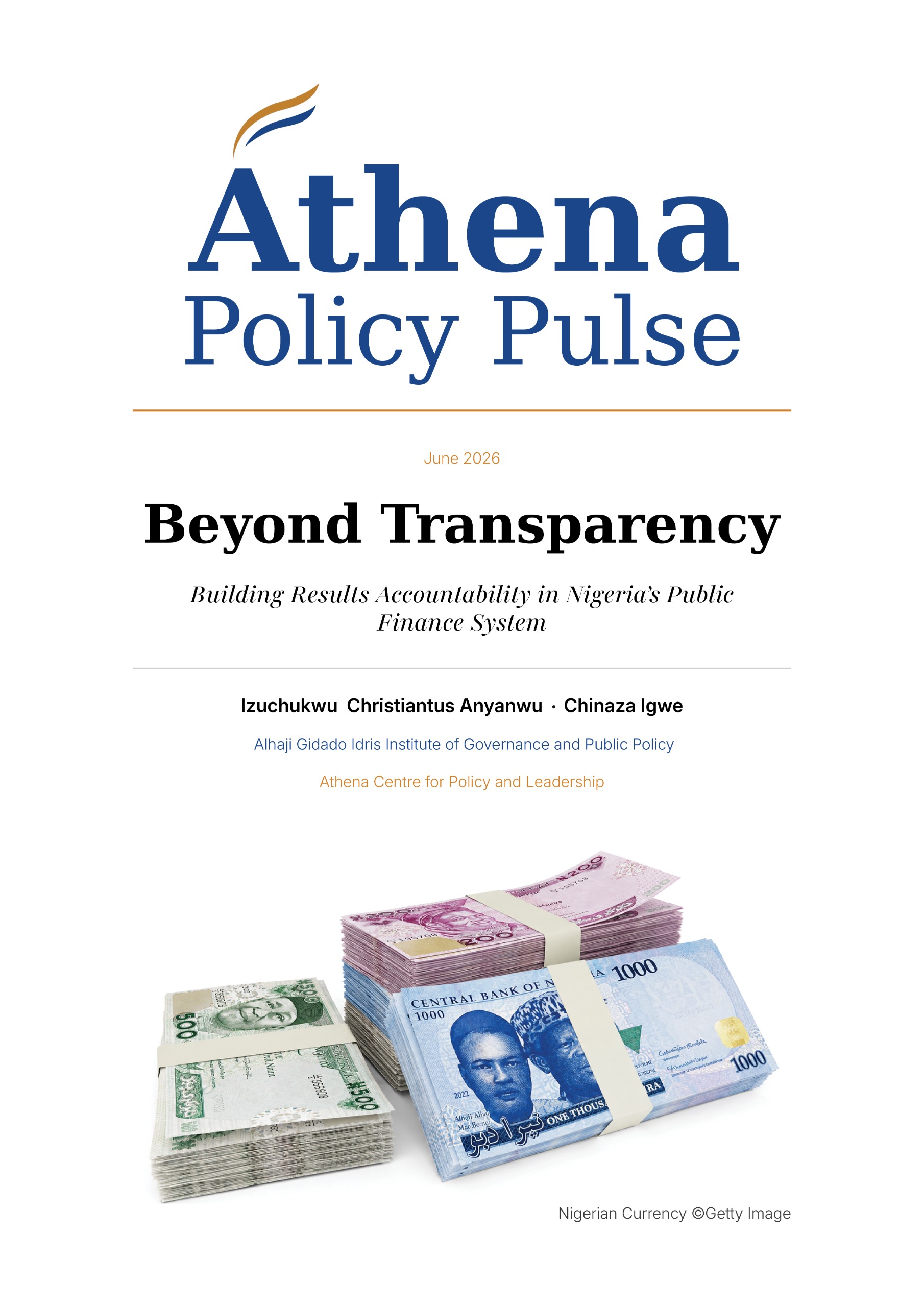

Nigeria’s public finance system has established strong mechanisms for tracking public expenditure but lacks an effective framework to ensure spending leads to measurable improvements in citizens’ lives, according to a report released Tuesday by the Athena Centre for Policy and Leadership.
The report, titled Beyond Transparency: Building Results Accountability in Nigeria’s Public Finance System, argues that the central challenge in Nigeria’s public finance is no longer tracking whether funds are spent, but verifying whether expenditure produces sustained public value.
Authored by Izuchukwu Christiantus Anyanwu and Chinaza Igwe, the publication highlights a persistent gap between significant budgetary allocations and real-world outcomes.
According to the report:
The 2026 Federal Budget stands at ₦27.5 trillion, with approximately 41.6 percent of federally retained revenue allocated to debt servicing in 2025.
Across the 2024–2026 Medium-Term Expenditure Framework (MTEF), major allocations included over ₦5.9 trillion for health, ₦7.4 trillion for education, more than ₦10 trillion for infrastructure, and roughly ₦5.8 trillion for defence and security.
Despite these substantial investments, the authors noted that increased spending has not consistently yielded improved healthcare access, better learning outcomes, enhanced transport efficiency, or superior security conditions.
The policy pulse frames the issue as institutional rather than purely fiscal. It points out that budgeting remains largely input-driven, legislative oversight prioritizes appropriation over past performance, and ministries, departments, and agencies (MDAs) are incentivized to execute budgets rather than deliver functional results. Furthermore, financial systems remain disconnected from sectoral performance data, while auditing remains focused heavily on compliance.
”Nigeria has built a transparency architecture without building a results-accountability architecture,” the report concluded.
To address these challenges, the Athena Centre outlined four key institutional recommendations:
Publish a results annex alongside the annual Appropriation Bill to explicitly link program allocations to target outcomes.
Mandate ex-post performance briefs from MDAs prior to the approval of new capital projects within the MTEF cycle.
Expand value-for-money audits and systematically integrate their findings into annual budget preparations.
Upgrade the Government Integrated Financial Management Information System (GIFMIS) to interface with sectoral outcome systems, transitioning it from a transaction ledger into a results-accountability platform.
The report identifies the upcoming 2027–2029 MTEF as a critical decision point for the nation’s financial governance, asserting that embedding performance metrics into budgeting, appropriation, and auditing will determine whether Nigeria’s public finance system evolves into a driver of public value or remains focused solely on expenditure management.

