

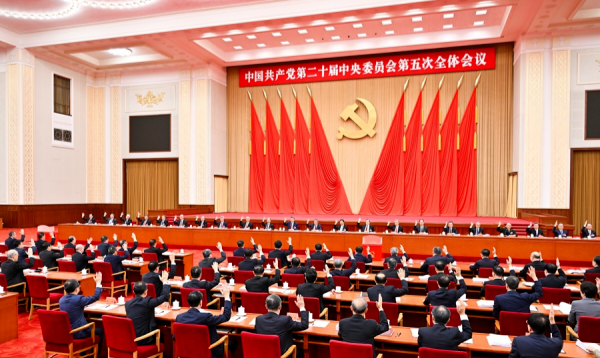
Xi-Led Plenum Reinforces Anti-Corruption Push, Party DisciplineAs Focus Shifts To 2027 Congress

China’s ruling Communist Party has signalled that discipline, accountability and internal unity will remain at the core of its governing strategy as the country moves towards a pivotal political milestone in 2027.
At the conclusion of the Fifth Plenary Session of the 20th Communist Party of China (CPC) Central Committee, senior leaders endorsed a sweeping resolution aimed at strengthening what the Party describes as “full and rigorous self-governance”, reinforcing oversight of officials and intensifying efforts to combat corruption.
The four-day meeting, chaired by President Xi Jinping, was as much about the Party’s future as its present.
Beyond endorsing new governance measures, the plenum formally confirmed that the CPC’s 21st National Congress will be held in the second half of 2027, setting the stage for a gathering expected to help shape China’s next phase of development and political leadership.
The message emerging from Beijing was clear: a stronger, more disciplined Party is viewed as essential to navigating the challenges that lie ahead.
In its communiqué, the Party pointed to continuing risks from corruption, governance pressures and an increasingly complex external environment.
Leaders argued that maintaining strict internal standards and effective supervision of officials is critical to achieving China’s long-term economic, security and modernisation goals.
The meeting reaffirmed Xi Jinping Thought on Party Building as the guiding framework for strengthening Party leadership and governance, underscoring the central role Party-building initiatives continue to play in policymaking.
Officials also backed further institutional reforms designed to improve oversight mechanisms, tighten management of cadres and strengthen anti-corruption systems.
The measures build on a campaign against graft that has remained a defining feature of Xi’s leadership over the past decade.
The Party’s determination to enforce discipline was further highlighted by the confirmation of investigations and disciplinary actions against a number of senior civilian and military officials accused of serious violations of Party rules and state laws.
In a notable personnel decision, Zhang Shengmin was elected to the Political Bureau, elevating him to one of the country’s most influential political bodies.
While the plenum focused largely on internal Party affairs, its decisions offer insight into Beijing’s priorities in the years ahead.
As China faces economic headwinds, geopolitical uncertainties and growing governance demands, the leadership is placing renewed emphasis on Party cohesion, oversight and discipline as the foundations for maintaining stability and advancing its long-term ambitions.
With the 2027 National Congress now formally on the horizon, the latest plenum serves as an early marker of how China’s leadership intends to prepare for the next chapter of the country’s political and development agenda.

