

Nigeria has called for the meaningful inclusion of women in peace processes and condemned all forms of conflict-related sexual violence, describing both issues as critical to achieving sustainable peace and security.
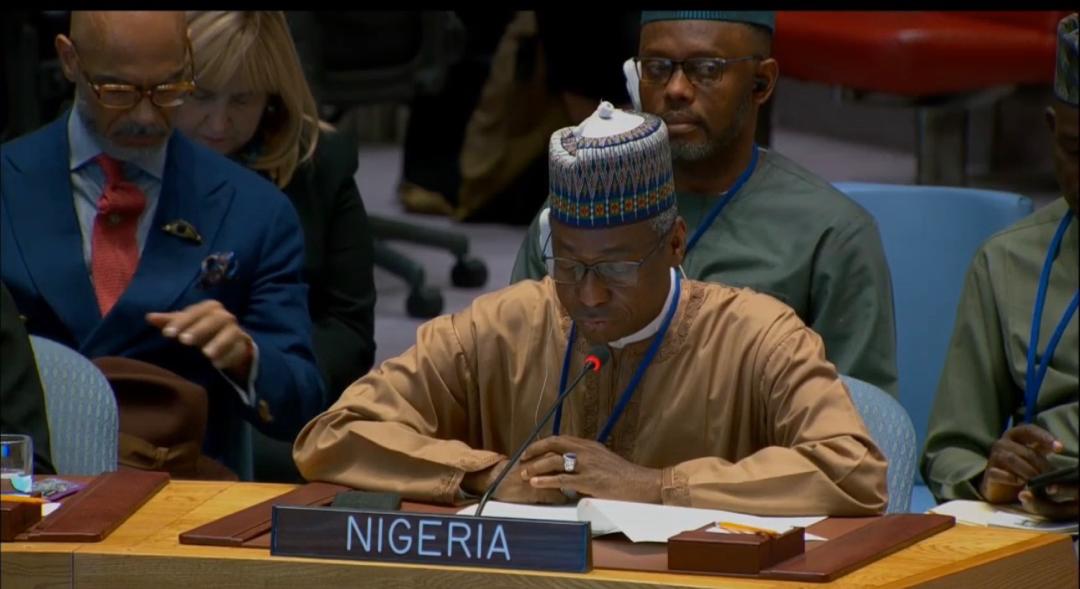
The call was made by the Permanent Secretary of the Ministry of Foreign Affairs, Ambassador Dunoma Umar Ahmed, at the United Nations Security Council Open Debate on Women, Peace and Security held at the UN Headquarters in New York on 27 October 2026.
Speaking during the debate themed “Women, Peace and Security in the Next Quarter-Century: Fulfilling the Promise Through Implementation,” Ahmed welcomed the UN Secretary-General’s report on Women, Peace and Security but expressed concern over the continued exclusion of women from UN-led peace processes.
He noted that women accounted for only five per cent of lead negotiators and 14 per cent of mediators across 57 negotiation processes in 2025, while only 10 peace agreements made explicit reference to women.
Ahmed also raised alarm over reports that cases of conflict-related sexual violence had more than doubled since 2024, describing the situation as particularly troubling for Africa amid ongoing conflicts in the Sahel, Lake Chad Basin, Sudan and the Great Lakes region.
According to him, the exclusion of women from peace efforts weakens fragile agreements, fuels renewed conflict and undermines prospects for lasting peace.
Drawing from Nigeria’s experience in the North-East, Ahmed said women and girls continue to bear a disproportionate burden in conflict situations, particularly through terrorism, abduction and displacement. Despite these challenges, he said women remain central to peacebuilding and recovery as mediators, first responders and members of security forces.
The Permanent Secretary highlighted Nigeria’s efforts to protect the rights of women and girls through the implementation of the National Action Plan on UN Security Council Resolution 1325 and the Violence Against Persons (Prohibition) Act.
He also cited Nigeria’s support for regional initiatives under the ECOWAS Regional Action Plan and the African Union’s Continental Results Framework on Women, Peace and Security.
To strengthen implementation of the women, peace and security agenda, Ahmed proposed three key measures.
He called for the institutionalisation of women’s participation in peace processes and urged the United Nations, African Union and Regional Economic Communities to systematically include qualified women in mediation and peace efforts.
He also advocated predictable financing for national and local action plans, including support for women-led organisations operating in conflict-affected communities, as well as the preservation of gender expertise in peace operations.
On accountability, Ahmed stressed the need to place survivors of conflict-related sexual violence at the centre of protection and justice efforts while ensuring perpetrators are held accountable through national justice systems with international support where necessary.
He further called for access to medical care, psychosocial support and economic opportunities for survivors, including women and girls formerly held by terrorist groups.
He also urged member states to address technology-facilitated violence, which he said increasingly threatens women’s participation in public and political life.
Ahmed reaffirmed Nigeria’s commitment to working with the UN Security Council, the African Union and other partners to advance the objectives of UN Security Council Resolution 1325 and improve outcomes for women

