


China marked a significant milestone in its maritime engineering sector on Wednesday with the completion of the “Celsius Georgetown,” the largest Liquefied Natural Gas (LNG) carrier ever designed and built within the country.
The delivery, which took place at the China Merchants Industry (CMI) Haimen Base in Nantong, Jiangsu Province, officially expands the elite club of Chinese shipyards capable of producing high-complexity LNG vessels to five.
Vessel Specifications and Environmental Impact
Built for the Danish shipowner Celsius Shipping, the “Celsius Georgetown” is a massive achievement in naval architecture. The vessel measures 298.8 meters in length and 48 meters in width, with a total cargo capacity of 180,000 cubic meters.
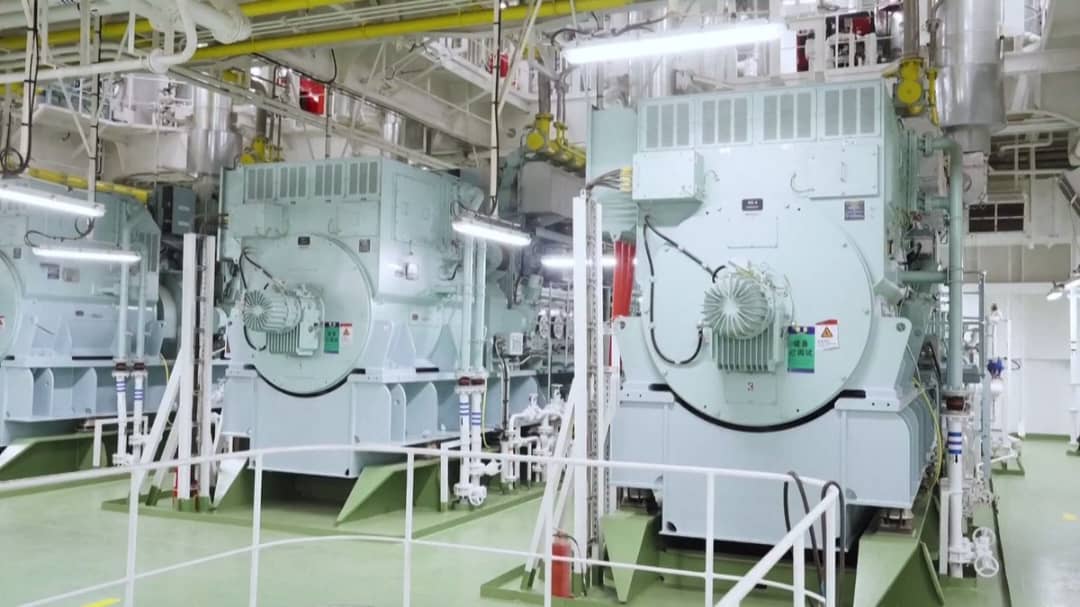
A key feature of the ship is its advanced dual-fuel propulsion system. This technology allows the vessel to utilize evaporated natural gas as fuel, significantly reducing cargo waste and lowering the evaporation rate. These enhancements ensure the carrier meets the rigorous environmental standards set by the International Maritime Organization (IMO).
Strategic Growth in Shipbuilding
The completion of the “Celsius Georgetown” highlights China’s rapid ascent in the global LNG carrier market—a sector historically dominated by South Korean shipbuilders.
- Expanded Capacity: With CMI Haimen Base joining the ranks, China now has five shipyards capable of delivering large-scale LNG carriers.
- Market Share: Recent data from S&P Global indicates that Chinese shipyards now hold approximately 85 of the 292 active global orders for LNG carriers.
- Technological Shift: The vessel is the first in a series of 12 ordered by Celsius Shipping from CMI, signaling a long-term shift toward Chinese manufacturing for high-spec global energy infrastructure.
LNG carriers are widely considered among the most difficult merchant ships to build, requiring the ability to maintain cargo at temperatures as low as -163°C. By mastering this design domestically, China continues its push into high-value, “green” maritime technology.

