
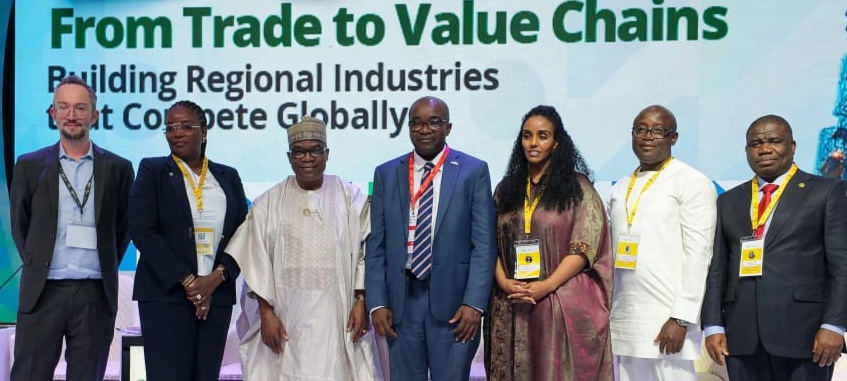

The Minister of State for Foreign Affairs, Ambassador Sola Enikanolaiye, has called for stronger collaboration between government and the private sector to accelerate Nigeria’s transition from a trade-driven economy to one anchored on value chains and industrial development.
Speaking at the 32nd Nigerian Economic Summit (NES #32) during a high-level panel on “From Trade to Value Chains: Building Regional Industries to Compete Globally” under the sub-theme Invest Nigeria, Enikanolaiye said partnerships would be critical to achieving sustainable prosperity and economic transformation.
The Minister said the Tinubu administration’s reordered 4D foreign policy doctrine places the welfare and prosperity of Nigerians at the centre of diplomacy, with emphasis on Demography, Development, Democracy and Diaspora.
According to him, democracy should serve as a vehicle for economic development and improved living standards.
“Democracy is good, but it is a means to an end, not an end in itself. Democracy must deliver on core priorities of economic development and economic prosperity to our people,” he said.
Enikanolaiye stressed that government alone could not mobilise the resources required to achieve national development objectives, noting that deeper engagement with the private sector was essential.
“We need mobilisation of capital, not just from foreign sources, but from domestic business, which is also very key,” he said.
The Minister described Nigeria’s large youth population as a major asset and urged increased investment in human capital development, particularly in small and medium-scale enterprises (SMEs), technology, innovation and creativity.
He said such investments would help create jobs, expand wealth creation and raise incomes.
Enikanolaiye also pointed to improvements in Nigeria’s macroeconomic environment, saying greater stability was creating a more predictable climate for business planning and investment decisions.
On foreign policy reforms, he said efforts were underway to make the Ministry of Foreign Affairs more responsive to the needs of ordinary Nigerians and more open to partnerships with the private sector.
He added that Nigeria could leverage engagements with neighbouring countries, West Africa, Africa and the wider international community through government-to-government (G2G), government-to-business (G2B) and business-to-business (B2B) partnerships to build globally competitive regional industries.
Also speaking at the session, President of the ECOWAS Commission, Dr Omar Alieu Touray, represented by Commissioner for Economic Affairs and Agriculture, Dehpue Yenpea Zuo, underscored the need for industrialisation across the region.
He argued that trade agreements alone would not create jobs without industries capable of producing goods and adding value.
According to him, intra-African trade remains significantly have yet to develop at scale.
He noted that the ECOWAS market, with more than 300 million consumers, provides an immediate opportunity for Nigerian manufacturers to expand production and achieve competitiveness before targeting broader continental markets under the African Continental Free Trade Area (AfCFTA).
The ECOWAS Commission President outlined four priorities for the region: implementing existing agreements, strengthening regional value chains, improving access to finance for producers and measuring success through jobs created and goods processed within West Africa.
He maintained that industrialisation remains central to unlocking the region’s economic potential and driving sustainable growth.

