

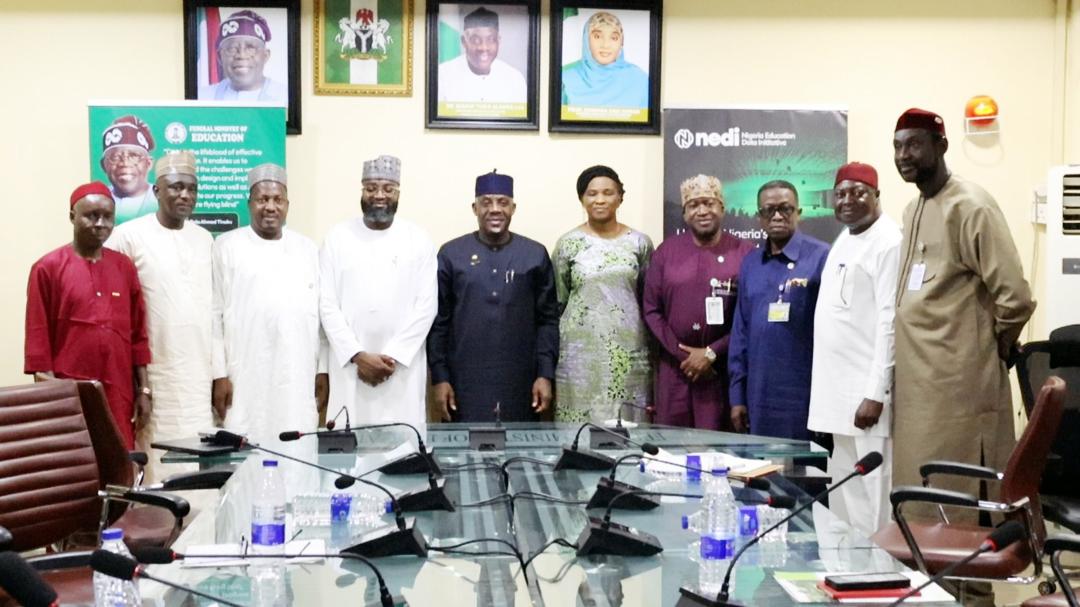

The Minister of Education, Dr. Maruf Tunji Alausa, has called for a fundamental shift in Nigeria’s research culture, urging universities and NASENI to ensure that innovations developed in laboratories do not end on shelves or in academic journals but are patented, commercialised and transformed into businesses, jobs and practical solutions for the economy.
Alausa gave the charge on Monday at a presentation to Vice-Chancellors, Directors of Academic Affairs, Directors of Postgraduate Studies and the Federal Ministry of Education’s Directorate of University Education on the possibility of partnering with universities through the proposed NASENI Campus.
The Minister said the initiative offers an opportunity to connect university researchers with advanced laboratories, prototyping facilities, industry and investment, creating a pathway for promising ideas to move from the laboratory to the marketplace.
He stressed that Nigeria must deliberately move from research to commercialisation if the country is to fully harness its human capital, noting that research outputs should not end as academic publications or prototypes.
Drawing lessons from the innovation ecosystem around Cambridge, Massachusetts, Alausa said Nigerian researchers should be supported to patent their inventions, develop them into marketable products and work with investors to establish viable companies.
He said such a model would help transform human capital into human development, adding that stronger collaboration between universities and NASENI was essential to achieving the objective.
The Minister therefore urged NASENI to establish stronger affiliations with universities around its development centres, noting that the institutions have a vast pool of researchers, lecturers and students whose expertise could complement the agency’s work.
He said NASENI could provide the missing link between academic research and commercial success by supporting patenting, connecting researchers with venture capital and facilitating the creation of spin off companies.
Alausa also challenged the agency to explore lithium processing and battery manufacturing as Nigeria expands its renewable energy and industrial capabilities.
Earlier, the EVC/CEO of NASENI, Mr. Khalil Suleiman Halilu, outlined the agency’s efforts to bridge the gap between research and production in line with President Bola Ahmed Tinubu’s directive to move beyond prototypes and ensure that innovations reach the production stage.
Halilu explained that the proposed NASENI Campus, located within a 100-hectare free trade zone, is being developed as an integrated environment where researchers, professors, prototyping facilities, industries and commercialisation opportunities can operate together.
He noted that several factories and industrial facilities had already been established within the zone, providing an ecosystem for research, innovation and production.
The Vice-Chancellor of the University of Abuja, Professor Hakeem Babatunde Fawehinmi, said the university’s existing partnership with NASENI demonstrated the potential of the model being advocated by the Minister.
Fawehinmi said the collaboration had produced facilities including an integrated agriculture incubation centre, greenhouse facilities, automated poultry systems and tissue culture laboratories supporting undergraduate and postgraduate research.
He added that the university was ready to deepen the partnership in areas including dairy science and renewable energy.
Similarly, the Vice-Chancellor of Bayero University, Kano, Professor Haruna Musa, said the institution was exploring expanded collaboration with NASENI in nanotechnology, vaccinology, toxinology and mathematical modelling.
Musa disclosed that two BUK research projects had reached the final stage of NASENI’s research commercialisation grant process. They include a reusable sanitary pad project and the commercial production of sweet potato based starch derivatives.
Reaffirming the Federal Government’s commitment to the initiative, Alausa said the Ministry would continue to work with NASENI, universities and other stakeholders to build a functional pathway from research and innovation to investment, production and job creation.
He stressed that under President Bola Ahmed Tinubu’s Renewed Hope Agenda, the objective was not simply to produce more research, but to ensure that Nigeria’s knowledge, skills and innovations translate into products, enterprises, jobs and sustainable prosperity for Nigerians.

