

India is seeking to bridge differences among BRICS members as the expanded grouping prepares for its leaders’ summit in New Delhi, with officials saying negotiations are underway on a joint declaration despite disagreements within the bloc.
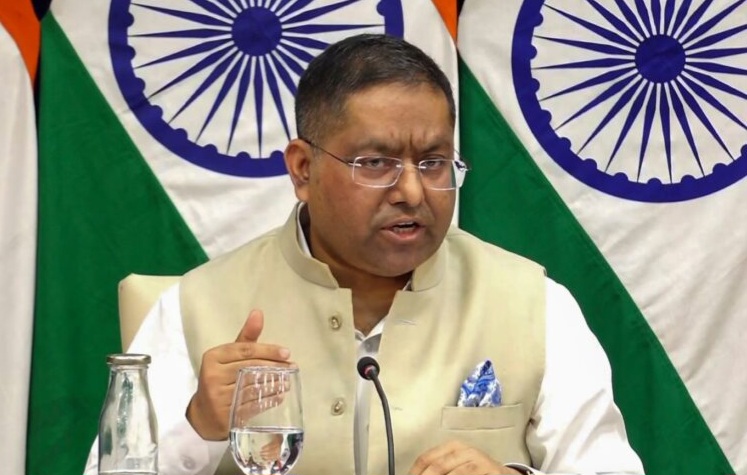
Speaking at a dinner for journalists and content creators in New Delhi ahead of the summit, Randhir Jaiswal, additional secretary and spokesperson at India’s Ministry of External Affairs, said New Delhi viewed all BRICS members as partners and wanted to strengthen cooperation across the grouping.
“India is friends with all BRICS member countries. As friends, it is our intention to bring all our partners together,” Jaiswal said.
Asked whether India had launched any specific initiative to narrow divisions among members, Jaiswal pointed to ongoing negotiations on the summit’s joint declaration.
“You will have to wait for the joint statement,” he said. “The joint statement is being negotiated and there you will see how India brings everybody together.”
Jaiswal said discussions were taking place collectively with all BRICS members but declined to identify countries involved in specific disagreements.
India will host the 18th BRICS Leaders’ Summit on Sept. 12-13 as the grouping adjusts to a more complex diplomatic landscape following its expansion to 11 members.
During its 2026 chairmanship, India has focused on resilience, innovation, cooperation and sustainability, while emphasising development priorities and strengthening the voice of the Global South.
Its economic agenda includes the proposed BRICS Economic Partnership 2030, measures to expand trade in services, strengthen resilient supply chains and improve financing for small and medium-sized enterprises.
However, the enlarged grouping includes countries with divergent geopolitical interests, complicating efforts to reach consensus on politically sensitive issues.
One of the most visible divisions has emerged between Iran and the United Arab Emirates. Around the BRICS foreign ministers’ meeting held in New Delhi in May, the UAE rejected Iranian allegations and defended its sovereignty and right to protect its national security, highlighting the challenges of formulating common positions among members with competing regional priorities.
Differences also persist between India and China. Despite recent efforts to stabilise ties following the 2020 border clashes, the two countries remain strategic rivals, with disagreements over security, technology and market access continuing to constrain cooperation.
Another source of tension lies between Egypt and Ethiopia over the Grand Ethiopian Renaissance Dam and the use of Nile waters. The dispute remains one of the most persistent issues between the two countries.
The matter gained fresh attention following Chinese President Xi Jinping’s state visit to Egypt on Sept. 1-2. In a joint communiqué issued during the visit, China recognised Egypt’s “legitimate right” to protect its water security, food security and development interests.
The two countries also called on Nile Basin states to comply with international law, including obligations related to preventing harm.
While the communiqué stopped short of explicitly endorsing Egypt’s position against Ethiopia, the inclusion of Nile-related concerns in a high-level China-Egypt statement adds another dimension to discussions within BRICS, where China, Egypt and Ethiopia are all members.
Differences also exist over the future economic direction of the bloc. Russia and China have supported greater use of national currencies and alternatives to Western-dominated financial systems, while India has generally taken a more cautious stance on proposals that could be viewed as positioning BRICS as an explicitly anti-Western grouping.
Russian presidential spokesman Dmitry Peskov said this week that Moscow does not seek “de-dollarisation” and remains open to alternative payment arrangements that are acceptable to participating countries.
The differing priorities underline the challenge facing India as it seeks to make the expanded BRICS framework more effective without requiring members to resolve longstanding geopolitical disputes.
Jaiswal said India’s approach was centred on practical cooperation and shared development goals.
“Our approach is development-focused. Our approach is people-focused,” he said, adding that India wanted to strengthen collaboration among member countries.
He described BRICS as a “complementary organisation”, noting that members also participate in a range of other international forums and institutions.
“The idea today is what is the need? The need is that we bring people together because there are so many uncertainties in the world,” Jaiswal said.
India hopes its economic agenda will provide common ground for the grouping. The proposed BRICS Economic Partnership 2030 is expected to focus on trade and investment, the digital economy, financial cooperation, industry and innovation. Ministers have also backed efforts to expand services trade, strengthen global value chains and improve access to finance for smaller businesses.
As leaders gather in New Delhi this week, the success of India’s chairmanship may depend on its ability to forge consensus around those shared economic and development priorities despite persistent geopolitical differences among member states.

