
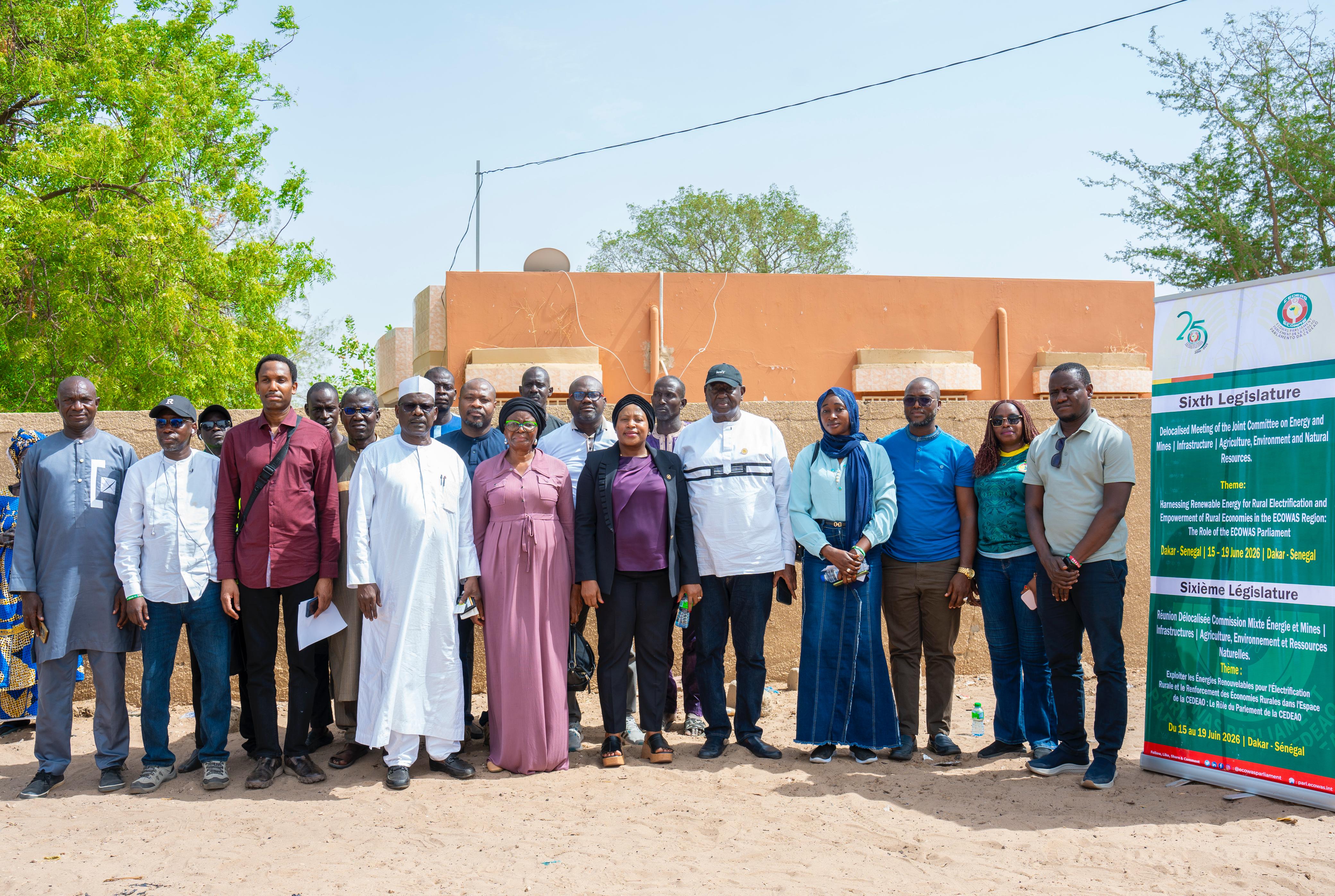

A joint delegation from the ECOWAS Parliament visited the commune of Ndiob in Senegal’s Fatick Region on June 18, 2026, to assess the impact and operational challenges of decentralized solar energy systems in rural West Africa.
The field visit was conducted as part of an ongoing delocalized parliamentary meeting focused on “Harnessing Renewable Energy for Rural Electrification and Strengthening Rural Economies in the ECOWAS Region.”
Led by Hon. Fanta Conté, the lawmakers met with Ndiob Mayor Oumar Bâ and officials from Green Impact West Africa, a private operator managing the local solar infrastructure under a mandate from Senegal’s Rural Electrification Agency (ASER).
Project Specifications and Impact
The Ndiob solar installation, commissioned in 2021 as a pilot rural electrification project, centers on a “Solartainer” power plant. The self-contained facility features a 40-foot container equipped with 144 photovoltaic panels generating a capacity of 50 kilowatt peak (50 \text{ kWp}), paired with a 134 kilowatt-hour (134 \text{ kWh}) TESVOLT lithium-ion battery storage system.
The plant distributes electricity to the villages of Bacco Dior, Bacco Sérère, and Bacco Mboytolle via a low-voltage network utilizing smart meters for remote monitoring and digital billing. According to project managers, the system currently serves:
100 households
20 small and medium enterprises
10 social institutions, including schools, health centers, and places of worship
Local surveys and resident testimonies indicate the project has displaced dependence on candles, kerosene lamps, and small generators. The introduction of reliable lighting and solar streetlights has improved household security and study conditions for children. Additionally, local artisans—including welders, carpenters, tailors, and mill operators have expanded operations, while health centers use the power to refrigerate critical medicines.
Operational and Capacity Challenges
Despite the socioeconomic gains, the field visit highlighted growing logistical and technical strain. Green Impact West Africa Managing Director Anna Ndiaye cited difficulties in maintaining and replacing equipment in remote areas, a continuous need for funding, and the challenge of navigating regulatory coordination between ASER and the national utility, SENELEC.
Furthermore, rising local demand has begun to outpace the facility’s initial 50 \text{ kWp} capacity, resulting in low and irregular voltage.
Ndiob resident Mustafa Faye noted that while the system has modernized the community, it can no longer support heavy appliances. “The electricity is low and not regular. We cannot even use air conditioners because the batteries cannot support them,” Faye said, urging further investment in high-efficiency battery storage and integration with the national grid.
Economic factors also persist, as some households face difficulties paying electricity bills during lean agricultural seasons.
Parliamentary Recommendations and Next Steps
During interactions with the community, ECOWAS lawmakers urged residents to leverage the infrastructure for economic independence. Hon. Ahmed Munir, Vice Chairman of the ECOWAS Committee on Infrastructure, advised youth to pursue entrepreneurship within the renewable energy sector, noting that conventional grid infrastructure cannot reach every community simultaneously.
Similarly, Senator Ali Ndume, Chairman of the Committee on Agriculture, encouraged women’s groups to pool resources and invest in solar-powered refrigeration to enhance food preservation and income generation.
Looking forward, Green Impact West Africa announced plans to expand its off-grid model to other unelectrified villages in the Fatick Region, introduce dedicated agricultural cold-chain systems, and strengthen public-private partnerships to align with Senegal’s national rural electrification strategy.

