

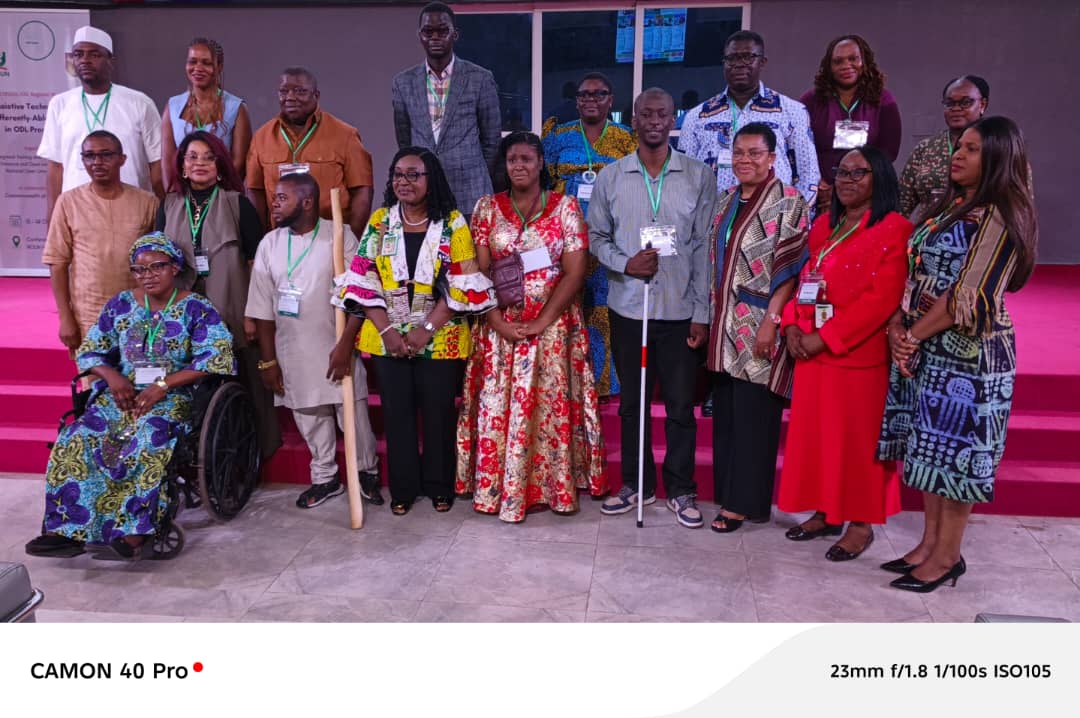

The National Open University of Nigeria (NOUN), in collaboration with the Commonwealth of Learning (COL), has called for greater investment in assistive technologies and inclusive learning systems to improve access to education for learners with disabilities across West Africa.
The call was made at a two-day regional workshop on Assistive Technologies for Differently-Abled Learners in Open and Distance Learning Institutions in West Africa, organised by the Regional Training and Research Institute for Distance and Open Learning (RETRIDOL), NOUN, in collaboration with COL.
Speaking at the workshop, Adviser on Higher Education at the Commonwealth of Learning, Professor Jane-Frances Agbu, said that although open and distance learning had expanded educational opportunities beyond geographical boundaries, significant barriers still prevented learners with disabilities from participating fully in the learning process.
Agbu noted that inaccessible learning environments, digital platforms and educational practices continued to limit the benefits of open and distance learning for some learners.
She identified assistive technologies, including screen readers, speech-to-text applications, captioning tools, adaptive devices and accessible digital platforms, as important tools for reducing these barriers and supporting independent learning.
According to her, the success of inclusive education should not be measured solely by the number of learners reached, but by how effectively they are supported to participate, learn with dignity, realise their potential and succeed.
She urged participating institutions to involve learners with disabilities in developing solutions to their educational challenges, stressing that their experiences and perspectives should inform policies and institutional practices.
Agbu also called on stakeholders to strengthen partnerships and develop practical, sustainable measures that would translate the workshop’s discussions into improved learning experiences across the sub-region.
In his opening remarks, the Vice-Chancellor of NOUN, Professor Uduma Oji Uduma, represented by the Deputy Vice-Chancellor in charge of Technology, Innovation and Research, Professor Christine Ofulue, said access to education alone was insufficient without appropriate support systems to enable learners with disabilities to participate meaningfully.
He emphasised that while assistive technologies could improve learning outcomes, technology alone could not guarantee inclusion without supportive institutional policies, accessible learning materials and responsive learner support services.
The Vice-Chancellor disclosed that NOUN had taken steps to promote inclusive education through the adoption of a policy on learners with special needs, the establishment of a special needs unit within its Directorate of Learner Support Services, and the creation of an interdisciplinary network on inclusive education.
He said the workshop provided an opportunity for participating institutions and countries to assess existing policies and practices, share experiences and identify strategies for strengthening support for learners with disabilities.
Uduma urged participants to develop practical recommendations suited to their respective institutional and national contexts, while renewing their commitment to improving the educational experiences of learners with disabilities.
Earlier, the Director of RETRIDOL, Professor Dorothy Ofoha, said the workshop was designed to strengthen the capacity of higher education institutions to integrate assistive technologies effectively into open and distance learning programmes.
Ofoha explained that RETRIDOL, established in 2003 through collaboration between NOUN and the Commonwealth of Learning, had continued to promote capacity development, research and regional cooperation in open and distance learning across West Africa.
She noted that despite the opportunities provided by open and distance learning, learners with disabilities still encountered challenges accessing digital platforms, learning materials, communication channels and assessment activities.
According to her, the workshop would enable participants to examine existing practices, exchange knowledge and explore ways to improve the availability and integration of assistive technologies into teaching and learning.
The workshop brought together academics, learner support professionals, instructional designers, policymakers, information technology specialists, open and distance learning practitioners, representatives of the National Commission for Persons with Disabilities and learners from across the West African sub-region.
Participants are expected to draw on shared experiences and expert contributions to identify practical approaches for creating more accessible and inclusive learning environments.
The organisers expressed optimism that the collaboration between NOUN and the Commonwealth of Learning would strengthen institutional capacity, encourage regional cooperation and advance equitable educational opportunities for learners with disabilities across West Africa.
Journalistic note: Before publication, please confirm the official spellings of the speakers’ names and titles, particularly Professor Jane-Frances Agbu, Professor Uduma Oji Uduma, Professor Christine Ofulue and Professor Dorothy Ofoha.

