

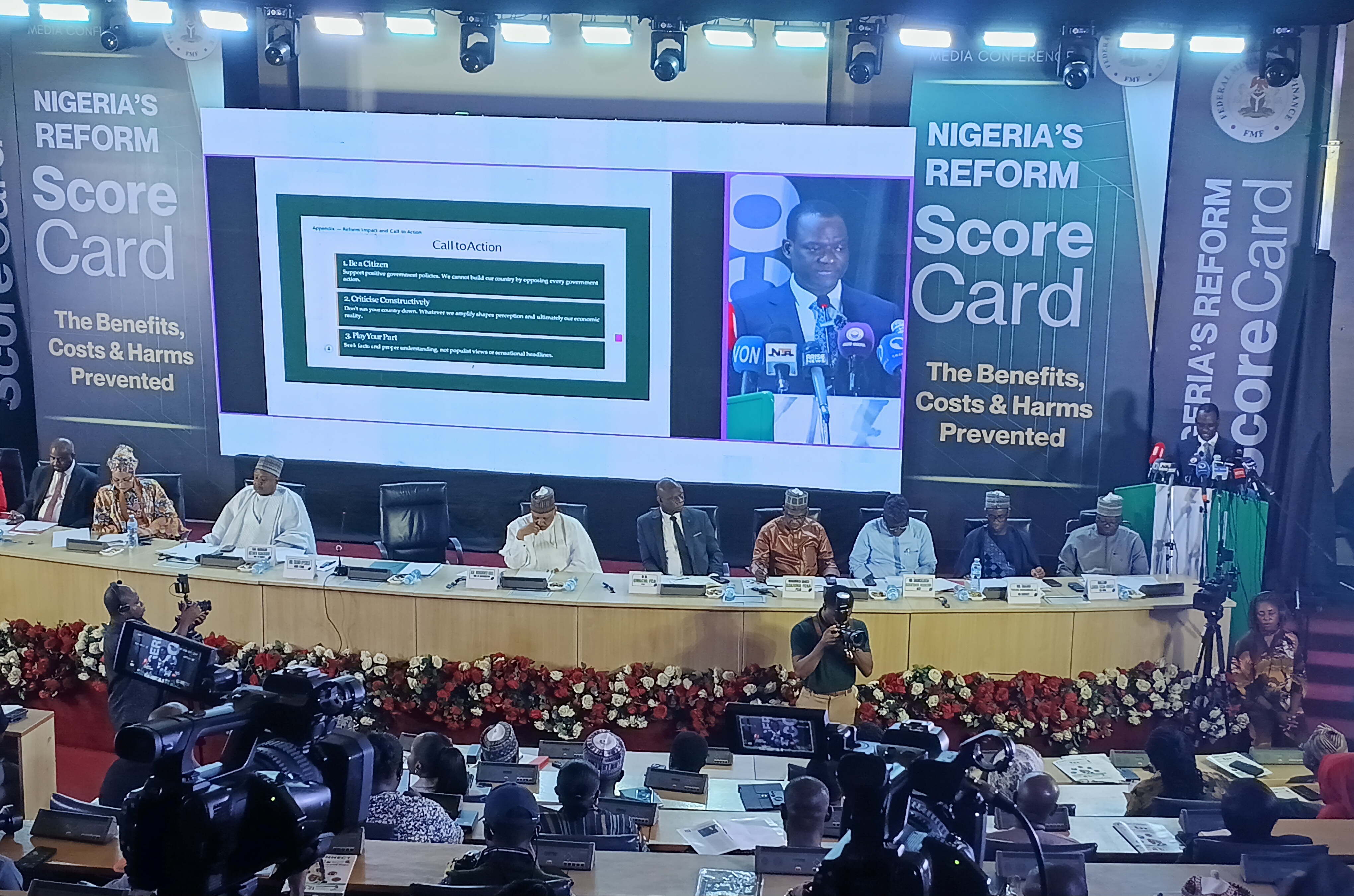

The Federal Government of Nigeria has presented a comprehensive “Reform Scorecard,” offering a detailed account of the financial impact, macroeconomic gains, and structural trade-offs resulting from major policy shifts including fuel subsidy removal and exchange rate unification between June 2023 and December 2025.
Speaking at a media briefing in Abuja, the Minister of Finance and Coordinating Minister of the Economy, Taiwo Oyedele, disclosed that policy adjustments generated ₦15.8 trillion in resource savings for the federation over the period.
According to Oyedele, the subsidy savings did not arrive as explicit central bank alerts, but manifested through higher Federation Account Allocation Committee (FAAC) collections via the Federal Inland Revenue Service (FIRS) and Nigeria Customs Service, driven by official exchange rate adjustments.
Out of the ₦15.8 trillion federation savings.
States and Local Governments received ₦10.4 trillion.
The Federal Government retained ₦5.4 trillion.
The Federal Government also generated ₦3.1 trillion in incremental independent revenue primarily through operating surpluses and remittances from government-owned entities and engaged in ₦11.9 trillion of incremental borrowing. In total, the federal government’s incremental resources reached ₦20.4 trillion.
Rising Expenditure and Public Debt
Oyedele outlined that incremental expenses during the same timeframe totaled ₦30.64 trillion, exceeding total additional inflows. Major drivers included.
₦9.39 trillion spent on public sector wage adjustments, allowances, and minimum wage increases a figure higher than the federal government’s direct share of subsidy savings.
₦9.37 trillion spent on external debt servicing, elevated largely due to foreign exchange depreciation.
”These decisions came at a real cost, and we’re not here to pretend otherwise,” Oyedele stated, noting that while households and businesses faced sharp price adjustments, the interventions prevented economic collapse and created necessary fiscal room.
Key Macroeconomic Indicators
The Finance Minister highlighted positive shifts in key economic metrics compared to pre-reform baselines.
Addressing the next operational phase, Oyedele stated that the government is focusing on translating macroeconomic stability into direct household relief.
Key priority areas include expanding cash transfers to vulnerable citizens, implementing targeted agricultural interventions to reduce food inflation, and advancing the implementation of the Nigeria Tax Act to broaden the tax-to-GDP ratio.
Minister of Budget and Economic Planning, Atiku Bagudu, contextualized the decisions, emphasizing that President Bola Tinubu inherited structural deficiencies, including $6 billion in unpaid petroleum import liabilities and low revenue-to-GDP ratios relative to global peers.
Minister of Information and National Orientation, Mohammed Idris, reiterated the administration’s commitment to transparency, noting that citizens have a right to understand how national resources are managed.
The complete scorecard comprising resource accounting, ten direct benefits and harms prevented, 25 comparative performance indicators, and an open methodology appendix will be hosted publicly on the Federal Ministry of Finance Website for public review.

