

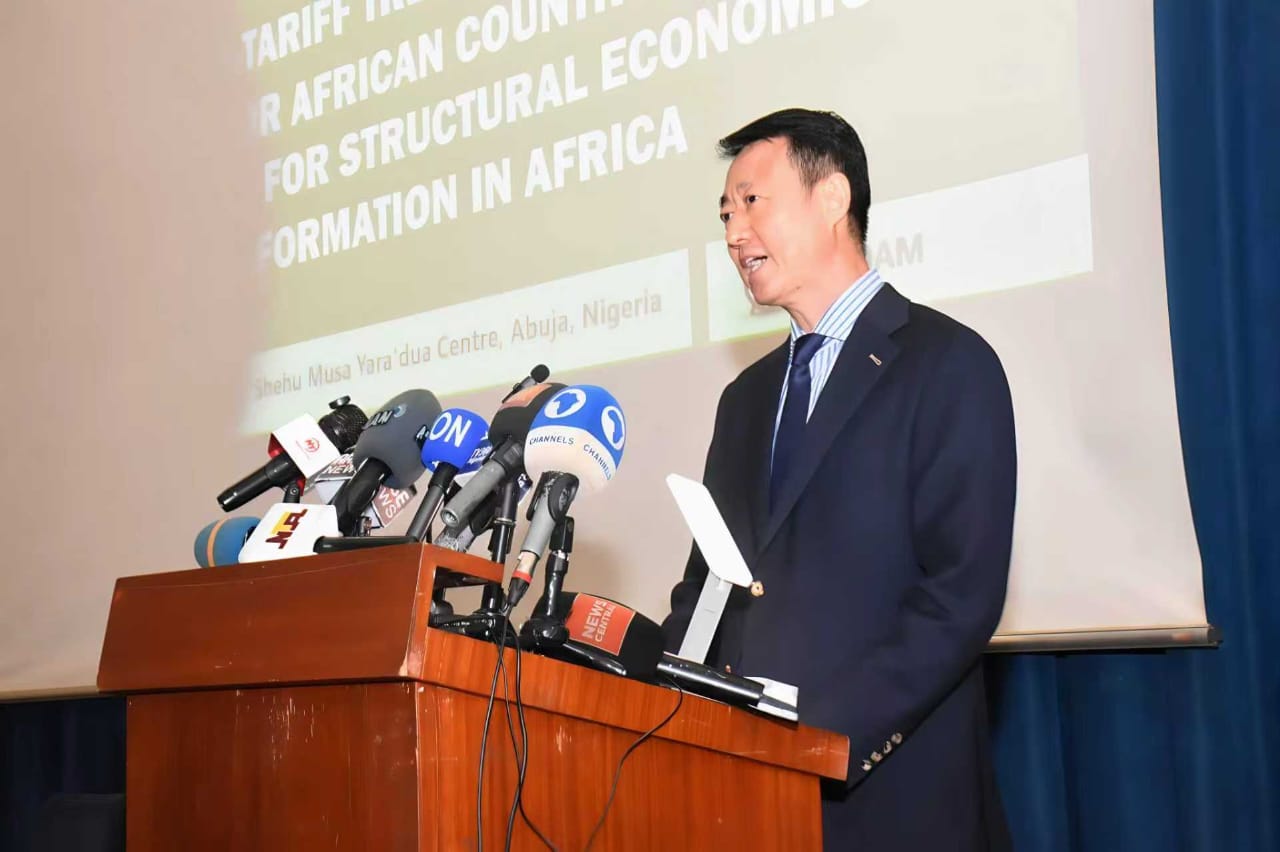

Stakeholders from diplomatic and government circles gathered at the Yar’Adua Conference Centre in Abuja on Friday for a high-level seminar on “China’s Zero-Tariff Measures and Africa’s Economic Structural Transformation.”
The event highlighted the initial economic impact of China’s zero-tariff policy while outlining Nigeria’s strategic shift from exporting raw commodities to driving local manufacturing and industrial processing.
Delivering the key address, the Chinese Ambassador to Nigeria, Yu Dunhai, revealed that trade between China and Africa reached a record $207 billion in the first half of 2026 following President Xi Jinping’s policy grant offering zero-tariff treatment to 53 African nations with diplomatic relations with Beijing.
According to Ambassador Yu, Chinese imports from Africa totaled $29 billion between May and June alone representing a 24 percent year-on-year increase with the tariff-free initiative boosting overall African exports to China by approximately 6 percent.
Nigeria’s trade performance saw significant expansion, with total bilateral trade rising 35 percent year-on-year to $18 billion in the first half of 2026.
Chinese imports of Nigerian goods surged 80 percent to $2.3 billion, driven by tariff eliminations ranging between 3 percent and 10 percent across key product lines, including agricultural exports, cattle bone granules, and liquefied propane.
Ambassador Yu urged African partners to establish formal Agreements on Economic Partnership for Shared Development with China to institutionalize trade preferences, while prioritizing supply chain stability, standardized quality control, and local processing hubs.
Responding on behalf of the Nigerian government, the Minister of Foreign Affairs, Ambassador Bianca Odumegwu-Ojukwu represented by Permanent Secretary Ambassador Dunoma Ahmed welcomed the duty-free market access but stressed that Africa must build the domestic productive capacity required to fully capitalize on trade concessions.
Aligning the national trade strategy with President Bola Ahmed Tinubu’s Renewed Hope Agenda, the Minister emphasized that foreign investments must go beyond raw material extraction to build factories, transfer technology, and create jobs within Nigeria.
“For Nigeria, the central question is not simply how much Africa can export to China, but what Africa will produce, how it will produce it, and how much value will be retained within African economies,” the statement read. “Our natural resources must become the starting point, not the end point of economic activity.”
Adding an agricultural perspective, the Minister of State for Agriculture and Food Security, Senator Aliyu Sabi Abdullahi, noted that while zero-tariff access opens new horizons, tariff removal alone cannot guarantee economic prosperity without modern processing facilities, efficient logistics, and sanitary certification.
Senator Abdullahi highlighted ongoing federal initiatives including the Special Agro-Processing Zones (SAPZ) project currently under development across multiple states—designed to convert comparative advantages in cassava, sesame, hibiscus, cashew, and livestock into high-value exports that meet international quality benchmarks.
Also speaking at the seminar, the Founder of the Centre for China Studies, Charles Onunaiju, emphasized the strategic importance of China’s 100 percent tariff line exemption for Africa, calling on domestic businesses and young entrepreneurs to leverage the African Continental Free Trade Area (AfCFTA) and regional processing networks to transform raw commodities into competitive industrial exports.

