

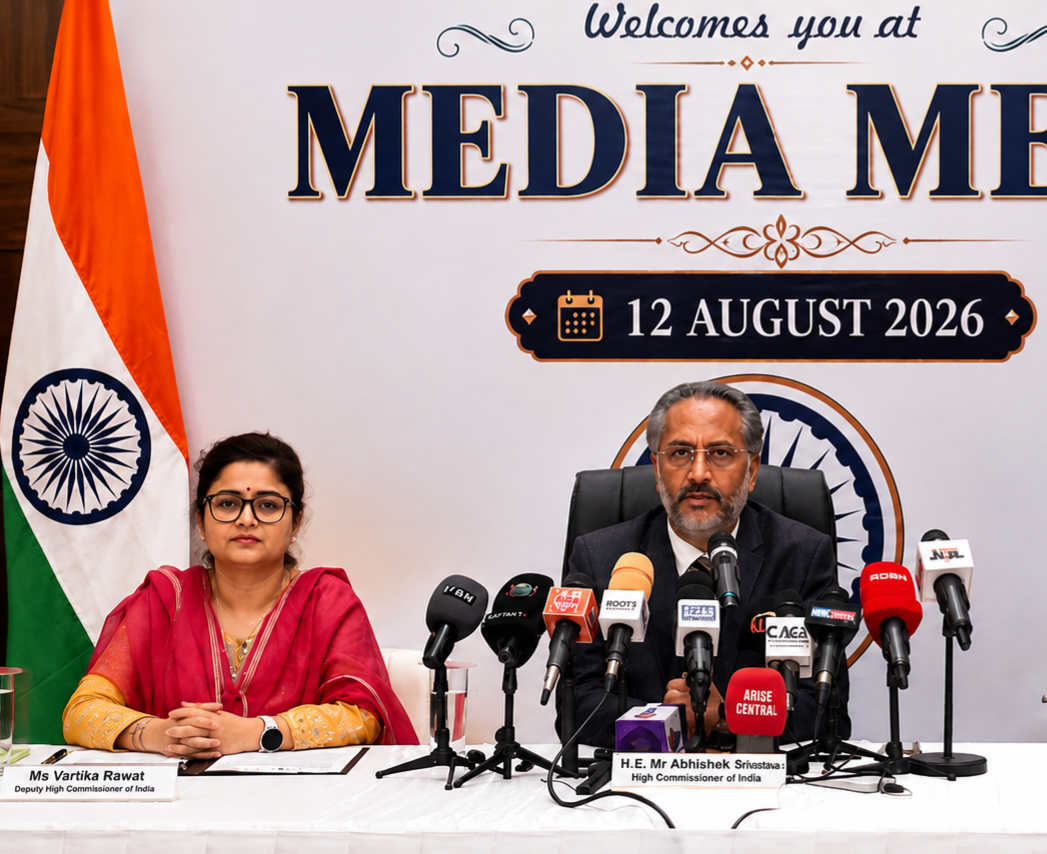

The Indian High Commission in Nigeria has announced a joint effort between India and Nigeria to combat the influx of fake and adulterated drugs into the West African nation.
Responding to questions at a media briefing organised to meet with the Diplomatic Correspondents’ Association of Nigeria (DICAN) in Abuja, the Indian High Commissioner to Nigeria, Abhishek Singh, disclosed that the collaborative enforcement operations are being spearheaded by Nigeria’s National Agency for Food and Drug Administration and Control (NAFDAC).
High Commissioner Singh revealed that India’s pharmaceutical exports to Nigeria reached $315 million in the 2024–2025 financial year.
Furthermore, Indian firms have invested approximately $4 billion in Nigerian pharmaceutical manufacturing, including an ultra-modern manufacturing facility currently under construction in Lagos to expand local production capacity.
Elaborating on the economic relationship, Deputy High Commissioner Vertika Rawat stated that India supplies roughly 40 percent of Nigeria’s overall pharmaceutical imports, with that figure exceeding 90 percent in specific drug categories.
Rawat emphasized that bilateral ties are shifting from pure importation to local capacity building. She noted that the strategy aligns with India’s role as “the pharmacy of the world,” transitioning toward manufacturing medicines directly within Nigeria for domestic consumption.
Highlighting potential areas for policy alignment, Rawat shared insights from India’s National Family Health Survey-6 (NFHS-6) a survey covering 679,000 families across 790 districts.
Findings showed that full childhood immunization (ages 12–23 months) in India rose to 87.1 percent, with over 96 percent receiving at least one vaccine and 95.6 percent utilizing public health facilities.
Rawat pointed to India’s public health strategies specifically the Ayushman Bharat health insurance program as a potential framework for Nigeria to evaluate in its drive toward Universal Health Coverage (UHC).
She also highlighted opportunities to scale up training for Nigerian healthcare professionals through the Indian Technical and Economic Cooperation (ITEC) programme.
The Deputy High Commissioner further cited socio-economic indicators from the survey, noting that the proportion of Indian women who have used the internet rose to 64.3 percent, while nearly 90 percent now operate personal bank accounts.
Rawat concluded that the historical ties between both nations, rooted in their shared anti-colonial struggles, are evolving into a modern strategic partnership focused on health financing, technology transfer, and industrial development.

