
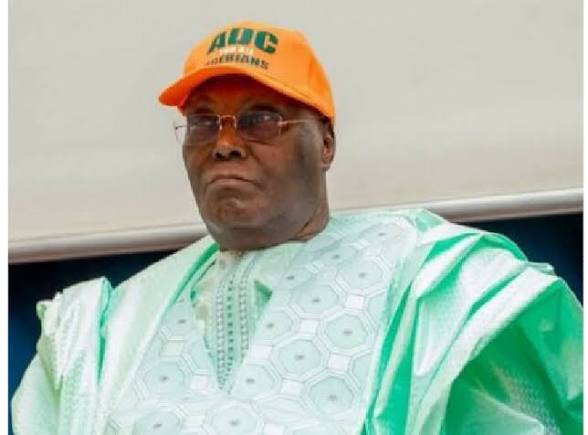

The Democratic Front (TDF) has described former Vice President Atiku Abubakar’s criticism of the Federal Government’s borrowing policy as mischievous and politically motivated.
In a statement signed by its Chairman, Mallam Danjuma Muhammad, and Secretary, Chief Wale Adedayo, the group argued that Atiku was using “narrow and short sighted metrics” to assess the necessity and viability of government borrowings for infrastructure development.
According to TDF, Nigeria’s huge infrastructure deficit requires sustained large scale investment that cannot be financed through existing revenues alone.
The group cited a recent economic survey by the Independent Media and Policy Initiative (IMPI), which estimated that Nigeria would need to spend at least $14.2 billion annually over a 10 year period to bridge its infrastructure gap.
“Our position is informed by the recent economic survey and analysis of Nigeria’s debt profile by the Independent Media and Policy Initiative (IMPI), based on credible empirical research, showing that Nigeria requires spending a minimum of $14.2 billion annually for a consistent period of 10 years to close the country’s huge infrastructural gap,” the statement said.
TDF questioned how Nigeria could generate such resources without either borrowing or imposing heavy taxes on citizens and businesses.
The group maintained that the President Bola Tinubu administration’s borrowing strategy was informed by the urgent need to address inadequate infrastructure, which it said had contributed to low productivity, rising unemployment, and widespread poverty.
According to TDF, many of the foreign loans secured by the government are tied to major infrastructure projects, including the Lagos Calabar Coastal Highway, Sokoto-Badagry Super Highway, Phase 1A of the Lagos Green Line, Kano Metro Rail project, and Kaduna Light Rail System.
It argued that these projects would ultimately generate economic returns capable of repaying the loans over time.
TDF also criticised Atiku over what it described as poor infrastructure investment during the administration in which he served as Vice President.
The group claimed that despite high crude oil revenues at the time, annual capital spending averaged about $3.5 billion, while the country experienced worsening infrastructure decay, power shortages, and weak economic productivity.
“We wonder how the former Vice President found the courage to condemn President Tinubu for embarking on the commendable route of reducing Nigeria’s infrastructural deficit with foreign loans tied to mega national projects,” the statement added.
The group further referenced IMPI Policy Statement 037, which it said identified the Tinubu administration as the highest spender on infrastructure in the last 25 years.
According to TDF, the policy group stated that no administration since 1999 had consistently committed comparable resources to infrastructure development.
TDF also argued that savings from fuel subsidy removal alone could not adequately fund Nigeria’s infrastructure requirements, insisting that strategic borrowing remained necessary for national development.
The group accused Atiku of using inflammatory language against the Tinubu administration out of political frustration, while also referencing controversies surrounding debt relief funds and power sector spending during previous administrations.
The statement urged Nigerians to continue supporting the current administration’s economic reforms and infrastructure drive.

