

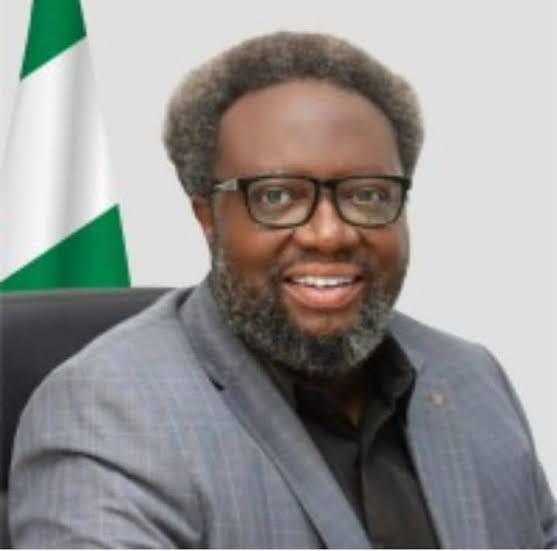
RMRDC Boss Backs Tinubu’s Re-election, Proposes 30% Local Value Addition Rule For Raw Materials Exports

The Director-General of the Raw Materials Research and Development Council (RMRDC), Prof. Nnanyelugo Martin Ike-Muonso, has disclosed that a proposed law requiring at least 30 per cent value addition to Nigeria’s raw materials before export has reached President Bola Tinubu for review.
Ike-Muonso said the proposed legislation, which seeks to promote local processing and manufacturing, would encourage investors to establish processing plants in Nigeria, create jobs and reduce dependence on imported finished products.
He disclosed this on Thursday in Abuja when the leadership of the Tinubu Support Group (TSG), led by its Director-General, Dr Umar Tanko Yakassai, visited the council to assess its achievements and challenges under the Tinubu administration.
According to Ike-Muonso, the President has directed the Ministry of Justice to review and strengthen the draft legislation before it is returned to the National Assembly.
He said the initiative was designed to ensure that Nigeria derived greater economic benefits from its abundant mineral and agricultural resources rather than continue exporting them in their raw forms and importing finished products at significantly higher costs.
The RMRDC chief also declared support for Tinubu’s re-election bid, arguing that continuity in government would help sustain ongoing economic reforms, accelerate industrialisation and advance the administration’s ambition of building a $1 trillion economy.
He said the council had aligned its programmes with the President’s Renewed Hope Agenda, particularly in the areas of local production, value addition, investment and employment generation.
“Value addition is what makes any country to be like any other country in the developed world. The only difference between us and the developed world is the extent to which we add value to the resources available to us,” he said.
Ike-Muonso explained that expanding local processing capacity would stimulate industrial development, attract foreign direct investment and create opportunities for manufacturers, small businesses and other players across the raw materials value chain.
Using agriculture as an example, he said processing farm produce into finished goods could generate employment and business opportunities for millions of Nigerians, particularly at the grassroots.
He disclosed that the council was already training women and other groups across the country in mushroom production and related value addition activities to strengthen local raw material value chains.
According to him, the interventions were intended to extend the economic benefits of Nigeria’s natural resources beyond extraction to processing, manufacturing and the development of local enterprises.
The RMRDC director-general also highlighted the council’s efforts to improve access to reliable information for investors, manufacturers and policymakers.
He said the council had developed the Nigerian Information System for Statistical Information on Raw Materials and Products, a platform designed to provide data on the location, producers, suppliers and value chains of raw materials across the country.
He added that the system was connected to other databases to help investors and manufacturers identify opportunities, assess resource availability and make informed business decisions.
Ike-Muonso further disclosed that the council had secured ISO 9001:2015 certification following an international assessment of its systems, describing the achievement as evidence of its commitment to efficiency, transparency and quality management.
Earlier, Yakassai said the delegation visited the council to obtain firsthand information about its activities, achievements and challenges to enable the support group to communicate accurate information about the administration’s policies and programmes to Nigerians.
He said the TSG played a significant role in mobilising support for Tinubu during the 2023 presidential election, coordinating more than 5,000 support groups nationwide.
According to him, the network had expanded since the election, with thousands of additional groups registered to support the administration and communicate its programmes to the public.
Yakassai said engagements with government agencies were necessary to help support groups understand the achievements and challenges of public institutions rather than rely on inaccurate information.
He commended Ike-Muonso and his management team for promoting local raw material development, value addition, research and industrialisation.
The TSG director-general also argued that governance was a continuous process, stressing the need for successive administrations to consolidate existing achievements while addressing emerging economic and developmental challenges.

