

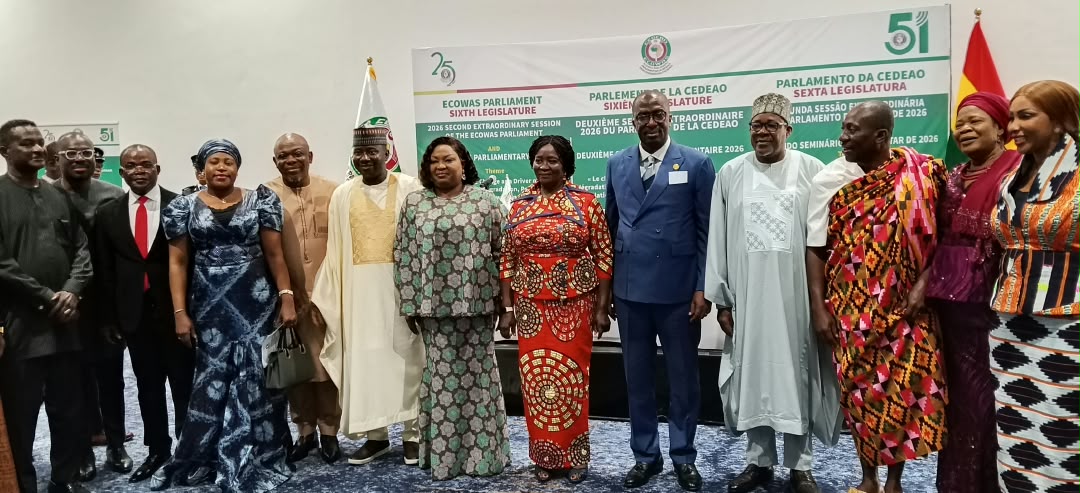

The Economic Community of West African States (ECOWAS) has warned that climate change is becoming a major driver of environmental degradation, population displacement and insecurity across the region, with projections showing that nearly 32 million people could be internally displaced by 2050.
Speaking at the opening of the Second 2026 Joint Parliamentary Seminar of the ECOWAS Parliament in Accra, President of the ECOWAS Commission, General Birame Diop, represented by Commissioner for Human Development and Social Affairs, Prof. Nassirou Bako-Arifari, described climate change as one of the greatest threats confronting the region.
The three-day seminar is being held under the theme, “Climate Change as a Driver of Environmental Degradation, Population Displacement and Rising Insecurity in the ECOWAS Region.”
General Diop said climate change had evolved beyond an environmental concern to become a development, humanitarian, peace and security challenge affecting the stability of ECOWAS member states.
He noted that rising temperatures, changing rainfall patterns, prolonged droughts, desertification, coastal erosion, flooding and the degradation of forests and farmlands were putting unprecedented pressure on livelihoods and communities across West Africa.
According to him, more than two million people were displaced in 2024 as a result of climate-related disasters, while over seven million others were affected by floods that destroyed homes, roads, schools, health facilities, farms and food reserves.
He further disclosed that between 2025 and 2026, the combined effects of climate change and other sources of insecurity led to the displacement of more than 12 million people across West and Central Africa, with women and children accounting for 80 per cent of those affected.
The ECOWAS Commission also expressed solidarity with the Government and people of Ghana following the June 2026 floods that claimed lives and affected thousands of residents.
Warning of a worsening crisis, Diop cited World Bank projections indicating that climate-related internal displacement in West Africa could reach nearly 32 million people by 2050 if urgent action is not taken.
“2050 is only 25 years away and coincides with the horizon of ECOWAS Vision 2050, under which member states have committed to building a peaceful and prosperous region,” he said.
The ECOWAS Commission highlighted steps already taken to address the challenge, including the development of a practical guide for implementing the Paris Agreement in 2020 and the adoption of the ECOWAS Regional Climate Strategy and Action Plan 2022-2030.
Diop also revealed that the Commission had since 2024 been pursuing the establishment of a regional carbon market platform in line with Article 6 of the Paris Agreement to help mobilise investments and address climate financing needs estimated at $294 billion for the region.
He urged parliamentarians to strengthen climate-responsive legislation, prioritise climate financing, improve disaster preparedness through early warning systems and promote sustainable management of land, forests, water and fisheries.
The ECOWAS Commission further called for women and young people to be placed at the centre of climate resilience efforts, describing them as innovators and agents of change rather than merely victims of climate impacts.
He stressed the need for stronger cooperation among member states in climate adaptation, disaster management, food and water security, environmental protection and the peaceful management of climate-related migration.
Calling for a new regional climate resilience and human security compact, Diop said governments must invest in resilience before crises occur, protect ecosystems before they are irreversibly damaged, create economic opportunities before communities are forced into displacement, and address grievances before they escalate into conflict.
He urged participants to ensure the seminar produces concrete recommendations capable of strengthening legislation, oversight and regional cooperation in tackling the growing climate challenge across West Africa.
“The challenge before us is enormous, but so is our collective capacity to respond,” he said. “Let us build an ECOWAS region where climate resilience is embedded in development planning and where natural resources become instruments of cooperation rather than sources of conflict.”
The most newsworthy elements are the 32 million projected climate-displaced persons by 2050, the 12 million displaced between 2025 and 2026, and ECOWAS’s push for a $294 billion climate financing agenda through a regional carbon market platform.
These figures elevate the story from a conference report to a major policy and regional security story.

