
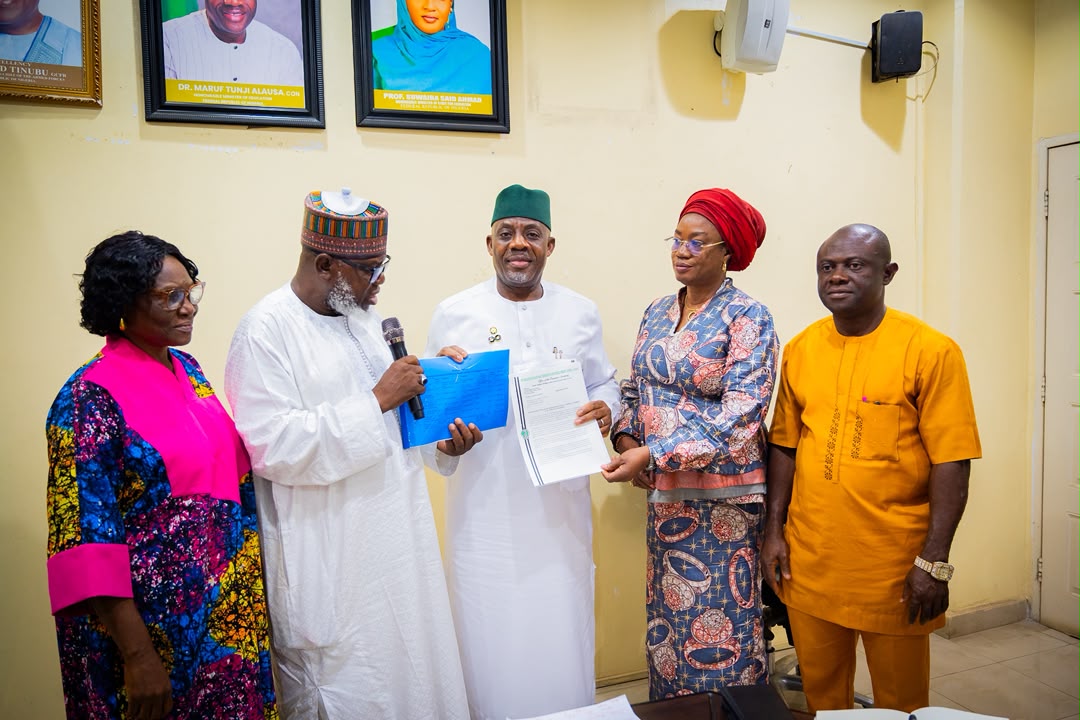

The Minister of Education, Dr. Maruf Tunji Alausa, CON, has set 70 per cent as the minimum score for textbooks to qualify for national ranking, warning that instructional materials that fall below the benchmark will not be allowed to compromise the quality of education in Nigerian schools.
Alausa, who spoke in Abuja while receiving the report and ranked list from Nigeria’s first national textbook assessment and ranking exercise, said some of the books submitted for assessment scored as low as 25 per cent.
Reacting to the findings, the minister described some of the materials being used in Nigerian schools as unacceptable.
«“Some of the books being used in our schools, primary schools, junior secondary schools and senior secondary schools are trash. Some of these books are scoring 25% or lower. Is this the way our children should be educated? If this happened with the government, it will not happen with this government,” he said.»
The minister said the 70 per cent threshold was deliberately established to ensure that only textbooks that meet an acceptable quality standard qualify for ranking.
He explained that publishers whose books failed to meet the benchmark would not be shut out of the process, but would be expected to study the assessment results, correct identified deficiencies and resubmit their materials.
“I’m giving you the olive branch,” Alausa told publishers, while commending those who participated in the exercise despite what he described as “pressure and blackmail.”
According to the minister, the assessment is part of the Federal Government’s wider quality-assurance drive following the introduction of the revised national curriculum in September 2025.
The National Educational Research and Development Council (NERDC) developed a standardised assessment toolkit, benchmarked against international best practices, to determine whether textbooks align with the revised curriculum and meet acceptable standards.
Curriculum alignment accounted for the largest share of the assessment at 51 per cent. Other criteria included language and style, instructional design, technical features, social and cultural compliance, and gender sensitivity.
Alausa said the assessment exposed significant disparities in the quality of textbooks submitted, with some scoring as low as 25 per cent.
The Executive Secretary of NERDC, Prof. Salisu Shehu, said the exercise was conducted in line with the council’s statutory mandate to develop, review and promote quality educational materials for the Nigerian education system.
Shehu said subject specialists, education experts and NERDC personnel participated in the assessment using an approved scoring framework. He added that the process included peer review and was not dependent on the judgment of a single official.
He reiterated that 70 per cent was adopted as the minimum standard for ranking, meaning that textbooks below the threshold would not qualify for inclusion on the ranked list.
The national assessment, the minister said, will be conducted in three cycles to cover all levels of the basic and senior secondary school curriculum.
The first cycle covers Primary 1 and 4, JSS 1 and SS 1; the second covers Primary 2 and 5, JSS 2 and SS 2; while the third covers Primary 3 and 6, JSS 3 and SS 3.
Alausa also announced that the national curriculum would henceforth be reviewed every three years to ensure that it remains responsive to emerging educational, technological and societal needs.
He said the textbook ranking exercise was not intended merely to produce a list of approved materials, but to establish a sustainable quality-control mechanism for instructional materials in Nigerian schools.
The minister said the Federal Government would continue to engage publishers willing to meet the benchmark, while those already meeting the standard would be expected to maintain and improve their quality.
He stressed that the ultimate objective was to protect the quality of learning, insisting that every textbook presented to a Nigerian learner must be accurate, curriculum-aligned and fit for purpose.
“Every Nigerian child deserves a textbook worthy of the education they are being prepared to receive,” he said.

