

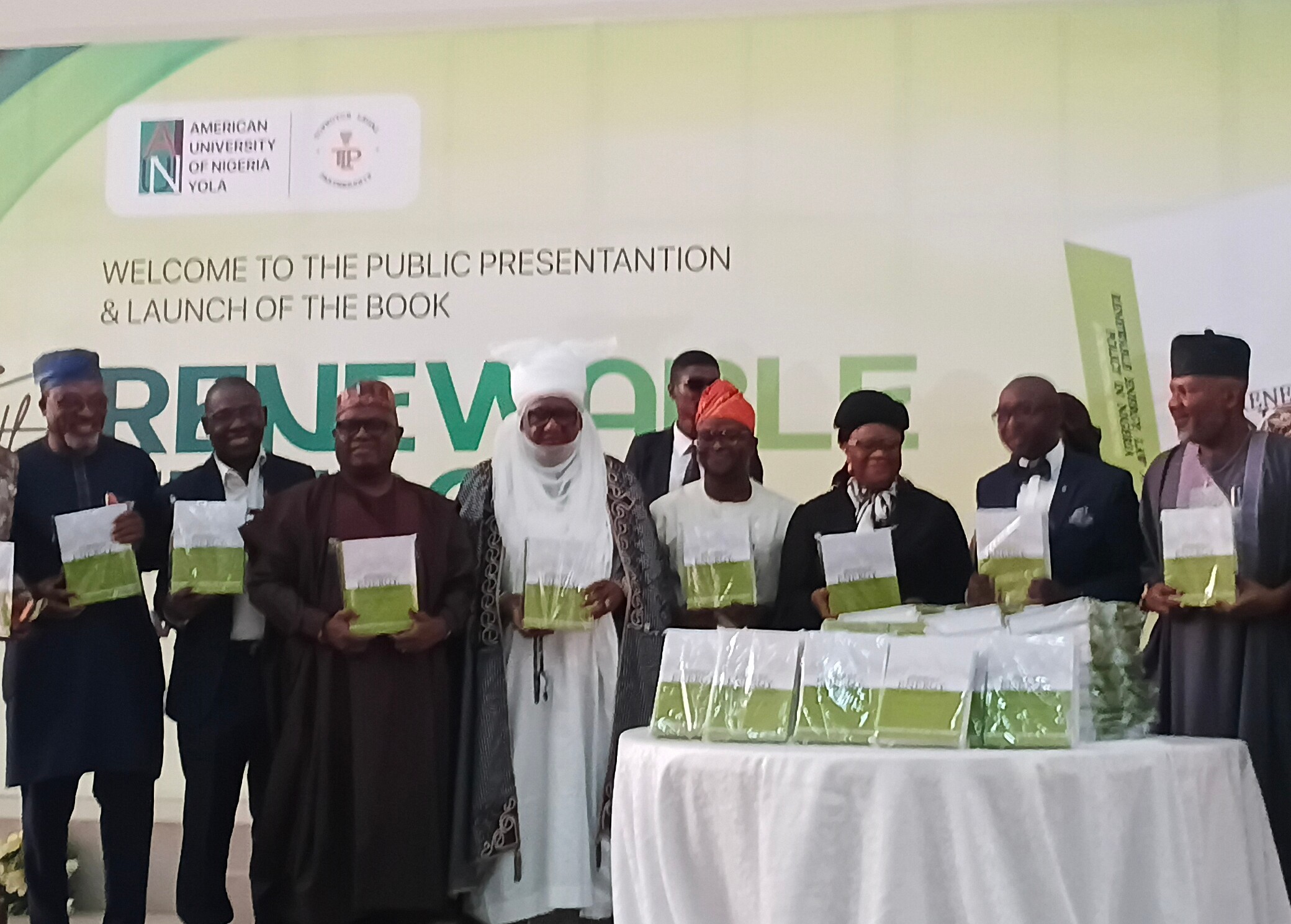

High-ranking political leaders and traditional rulers have called for a fundamental shift in Nigeria’s energy policy, asserting that the nation’s power challenges are as much a matter of legal framework as they are of technical infrastructure.
Speaking at the public presentation and launch of the book “Renewable Energy Law and Policy in Nigeria: A Cross-Cutting Perspective,” authored by Professor Bitrus Joseph Bulama, stakeholders emphasized that a robust legal environment is the primary catalyst for sustainable development.
A Policy Moment for the Nation
Former Vice President Alhaji Atiku Abubakar, represented by Maxwell Gidado, SAN, described the book’s release not merely as an academic milestone but as a “policy moment” for the country. Atiku noted that the work serves as a vital intervention at the intersection of law, governance, and development.
“Any serious nation must, at critical moments, pause to reflect on whether its legal and policy frameworks are fit for purpose,” Atiku stated. He praised Professor Bulama a beneficiary of his educational support initiatives as a prime example of the “return on investment in human capital.”
Atiku further argued that Nigeria’s energy crisis undermines the social contract, adding that renewable energy is a “legal and policy imperative” grounded in the need for social justice and the dignity of the human person.
Legislative Overhaul and Accountability
The Speaker of the House of Representatives, Tajudeen Abbas also represented at the event, highlighted the National Assembly’s commitment to transforming the sector. He pointed to the Electricity Act 2023 as the most significant reform since 2005, noting its role in decentralizing electricity generation and empowering states to create localized energy markets.
The Speaker revealed that under the current leadership, the House established a pioneering Committee on Renewable Energy. On October 25, 2025, the House resolved to investigate several critical areas to ensure the integrity of the sector, including the domiciliation of green energy projects across various MDAs, the management of foreign grants and investments received since 2015 as well as the progress toward a 50% renewable energy power mix for the House of Representatives.
“Renewable energy development is not driven by technology alone,” the Speaker noted. “It is enabled by sound law and regulatory certainty, which reduces investment risk and promotes private sector participation.”
A Call for Action
Traditional institutions also added their voice to the discourse. The Emir of Keffi, Alhaji Shehu Chindo Yamusa III, described the book as a “roadmap” for policymakers and investors to collaborate on a cleaner, more prosperous Nigeria. He urged stakeholders to treat the insights within the book as a “clarion call for action” rather than just a theoretical exercise.
The event concluded with a consensus that achieving the Renewable Energy Master Plan which aims for a 36% renewable electricity share by 2030 requires a disciplined alignment of engineering, law, and political will.

